The Ledger
Being an Account of Persons, Places, and Particulars
as Recorded in the Margins of Commerce
Every trading family kept a ledger. Columns for pelts received and goods exchanged. Pages for debts owed and debts collected. But between the lines—in the margins his mother annotated, in the blank pages his father left—Samuel Dunlap kept a different kind of record. The one that mattered.
This companion collects the people, places, and historical context of The Long Road Home. Some entries are written in plain ink—the facts of the frontier, visible to anyone who opens the book. Others appear in lighter hand, the kind of notation that only reveals itself to those who know where to look.
The Ledger grows with each new chapter. Like Samuel's own record, it is never finished—only carried forward.
Dramatis Personae
Plain ink for those whose names appear in the official record. Faded hand for those who preferred not to be written down.
Sixteen years old in the autumn of 1774. Son of a Scots-Irish trader and his Odawa-connected wife. Keeps his father's ledger with increasing unease, recording transactions that feel less like commerce and more like survival. Watches. Listens. Writes down what others would rather forget.
Built a trading post on the Detroit frontier through careful alliances and careful ledgers. His hand appears in the margins of every account book his son now carries. Absent from the story but present in every entry—the arithmetic of a life measured in pelts and provisions.
Moves between the fort and the settlements with an authority that neither soldiers nor traders quite understand. His French is immaculate, his loyalties less so. Knows more about the river trade than any man of the cloth should.
Carries out the orders of the Crown with the enthusiasm of a man who has found the one thing he is good at. Leads contraband raids. Asks questions designed to produce the answers he already wants.
Appears: Ch 6
The man who records what the Crown wants recorded. Counting day brings him out from behind his desk and into the trading posts, where his careful inventory serves purposes both commercial and political.
Appears: Ch 4
— the following entries were written in lighter hand —
A French-Canadian habitant who lives south of Detroit where the river widens. Mends nets, reads weather, and speaks in the measured cadence of a man who has survived by knowing when to be quiet. Takes Samuel in when the boy has nowhere else to go. His kindness is not generosity—it is strategy.
Operates a cabin south of Detroit that functions as a waystation for travelers the garrison would prefer not to know about. Speaks in building metaphors—tracing routes like a builder reading blueprints, laying down facts like foundation stones. Believes hope is mortar: it holds the stones together but won't keep the rain out by itself.
Appears: Ch 7
Her grandmother remembered when Detroit was still d'étroit—just a narrow place in the river, not yet a name on English maps. Quiet authority. Watches the door while Dumont talks.
Appears: Ch 7
Named for what the portage trails took from him. Moves through the network carrying things heavier than cargo. His injuries are the kind the frontier gives to men who carry loads that should require two.
Appears: Ch 5
Her hands move with the certainty of someone who has repaired what others have broken many times before. Tends to wounds left by the raid on Baptiste's camp. Asks no questions about how they were received.
Appears: Ch 6
Appears at the waystation. Speaks with the kind of authority that comes from knowing things before they happen. His name, if he has one, stays unrecorded.
Appears: Ch 7
Sells apples. Delivers messages. One of those children the frontier makes old before their time, carrying knowledge between people who cannot be seen speaking to each other.
Appears: Ch 4
The Network
Between the British garrison and the French settlements, between the fur traders and the nations who actually control the land, there exists an economy that appears in no official ledger. Samuel calls it the hush economy—a web of whispered agreements, cached supplies, and favors owed that keeps the frontier functioning when the official system fails.
The network has no name, no leader, no headquarters. It has nodes: Baptiste's camp, Dumont's waystation, the trading posts that keep two sets of books. It moves cargo by bateau and information by apple boy. It survives because everyone in it understands the same rule—some things need to stay spoken, not written.
This section will expand as the network reveals itself through future chapters.
Annotations Index
Historical notes and context markers from the chapter margins. Click any chapter link to read the annotation in context.
Chapters 1–4
Small boat used in the Great Lakes fur trade
Flat-bottomed river craft, the workhorse of frontier commerce
Chapter 5: Shore Work
French-Canadian habitants along the Detroit River
Knot used to join two ropes of different thickness
Fish trap constructed in shallow water using stakes and woven barriers
Freshwater drum, common in Great Lakes fisheries
The informal trade network operating outside British regulation
French-Canadian farmer-settlers under the seigneurial system
Chapter 6: The Raid
Ottawa war chief whose 1763 rebellion reshaped British policy in the Great Lakes
Biological warfare at Fort Pitt, 1763 — documented in the historical record
British enforcement actions against unlicensed frontier trade
Indigenous and habitant practice of interpreting river ice for safe travel
Chapter 7: The Waystation
Informal safe houses along frontier travel routes
The waystation keeper and his role in the network
Hidden supply stores beneath frontier cabins
Traditional healing practices on the frontier
Pre-positioned river craft for rapid movement through the network
Chapter 8: The Choice
Early Freemasonry as a covert network of trust among merchants and officers
Sophisticated sympathetic inks used for hidden communications
Hidden resistance meeting spaces within local Catholic churches
Informal surveillance by the military and counter-surveillance by the network
Timeline
Events as they unfold, season by season.
The Upper Country, 1774
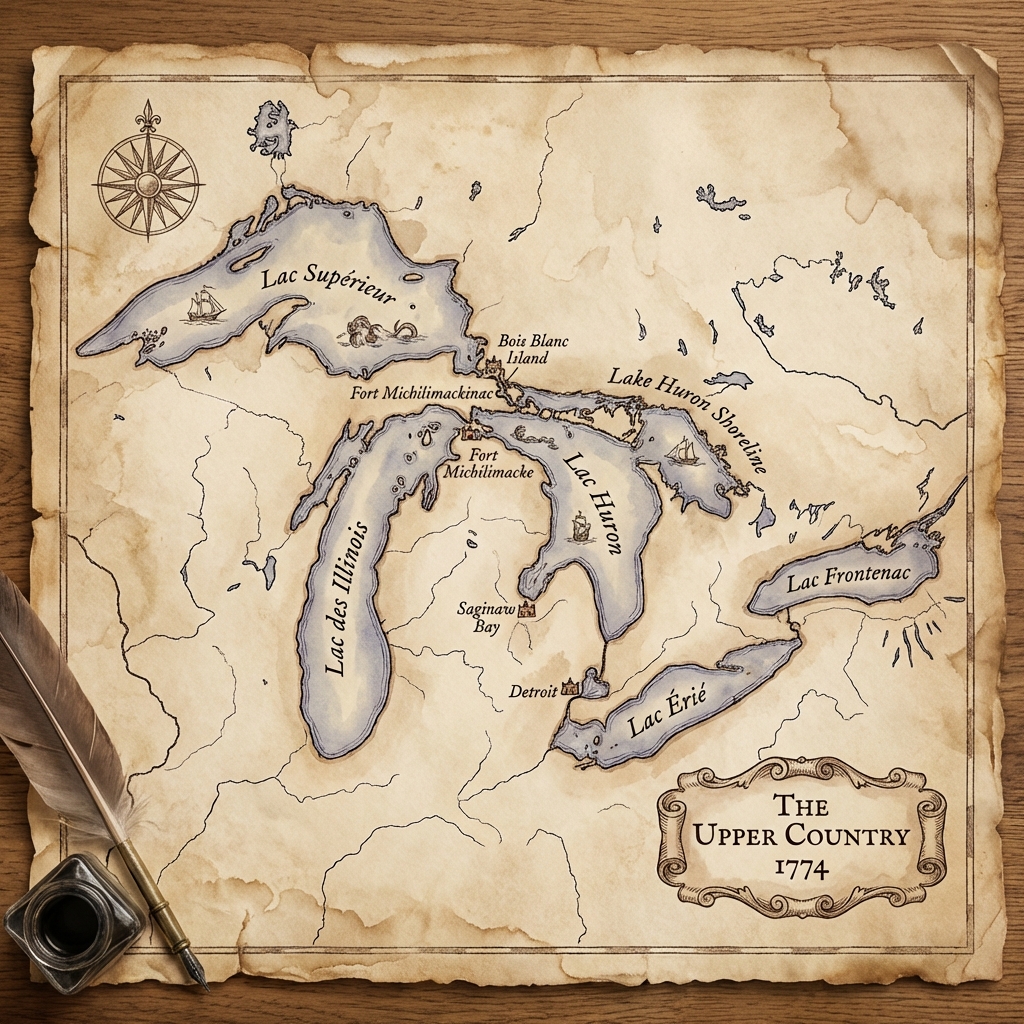
The Upper Country — Detroit and the Great Lakes frontier, 1774
In 1774, Detroit was not yet American. It was British by treaty, French by culture, and indigenous by right. The Upper Country—le pays d'en haut—stretched from the western end of Lake Erie to the headwaters of the Mississippi, a territory larger than most European nations and governed by no single authority.
The map above traces the routes Samuel travels and the places where the network operates. Each chapter adds new points to the geography of survival.
Glossary
Terms of the trade, the trail, and the times.
Flat-bottomed boat, typically 30–40 feet, used on rivers and lakes. The backbone of frontier logistics.
French-Canadian farmer-settler. Under the seigneurial system, habitants held land grants and owed labor to the seigneur.
Samuel's term for the informal trade network operating outside British customs and regulation.
French: "the upper country." The vast territory surrounding the Great Lakes, governed by overlapping European and indigenous claims.
Overland carry between navigable waterways. Portage routes were the highways of the interior, and controlling them meant controlling trade.
A knot for joining ropes of different thickness. Essential for net repair and frontier rigging.
Licensed fur-trade canoe men. Paddled 14–18 hours per day, carried 180-pound packs over portages, and sang to keep time.
An unofficial stop along frontier travel routes. Part inn, part intelligence post, part supply cache.
Fish trap built in shallow water from stakes and woven barriers. Indigenous technology adopted by habitants throughout the Great Lakes.
Small sailing vessel with a mainsail and a smaller mizzen. Used for coastal and lake navigation in the fur trade era.
Support This Work
The Long Road Home is free to read. If the story moves you, consider supporting it.
Buy Me a Coffee