The Upper Country, 1774
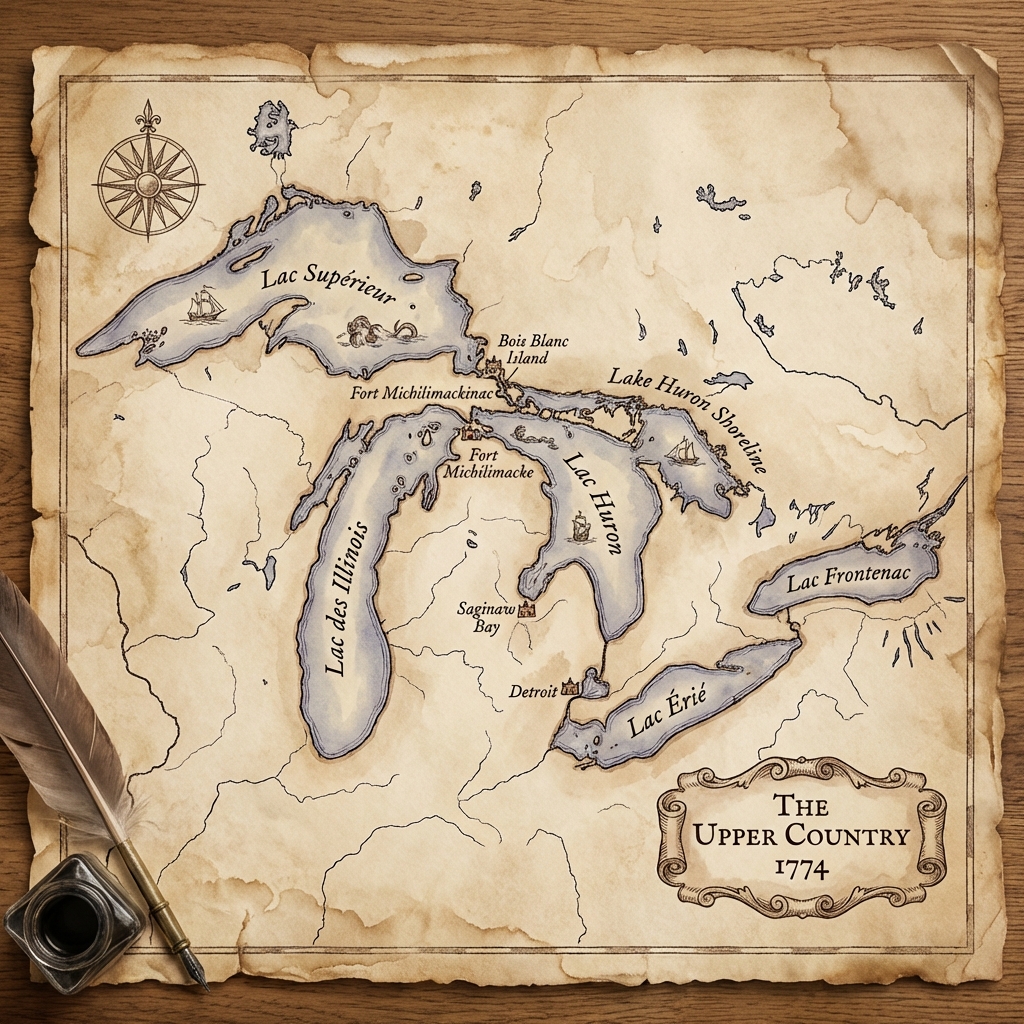
Samuel's journey from the Straits to Detroit.
Samuel's journey from the Straits to Detroit.
Early-Mid December 1774 — South of Detroit
The river road to Baptiste's camp took three hours when the mud was frozen, six when it wasn't. This morning, December's mood swung between the two—frozen at dawn, soup by noon, a sucking misery that grabbed at Samuel's boots like it had opinions about his destination.
Baptiste Morin kept his fishing camp twelve miles south of Detroit where the river widened and the authorities thinned. Samuel had been ordered there by the silver-haired man with instructions that sounded simple: “Learn the shore. Learn the people. Learn what moves when the Crown isn't watching.”
What that really meant, Samuel discovered, was learning Baptiste.
The old voyageur sat on an overturned boat, mending nets with fingers that moved like water—fluid, purposeful, impossible to interrupt. He didn't look up when Samuel approached.
“You're late.”
“The mud—”
“The mud was here yesterday. Will be here tomorrow. You plan for mud or mud plans for you.” Baptiste held up the net, examining his work through the mesh. “Your father knew that.”
Samuel's chest tightened. “You knew my father?”
“Knew of him. Traded with him twice. Honest weights, fair payment, no haggling after hands were shook.” Baptiste finally looked up. His face was all angles and weather, carved by forty winters on the lakes. “Heard what happened. Wray's a bastard. Everyone knows it.”
They stood there, Samuel not knowing what to say, Baptiste not needing him to say anything. Finally, the old man pointed at another pile of nets.
“Those need mending. You know the sheet bend?”
“Yes.”
“Show me.”
Samuel picked up the net, found a tear, began working. His fingers remembered the knot from childhood, from watching his father repair their own nets on slow afternoons when the post was quiet. The motion brought memory—his father's hands guiding his, his mother humming while she worked the ledger, the smell of tar and hemp and home.
“You're crying into my nets,” Baptiste observed.
Samuel wiped his face, embarrassed. “Sorry.”
“Don't apologize for grief. Just don't let salt rot the hemp. Nets are expensive.”
They worked in silence until noon. Then Baptiste stood, stretched his back with a sound like ice breaking, and walked to his shelter—a low structure built from driftwood and canvas, invisible from the river unless you knew to look.
“Hungry?”
Samuel's stomach answered before his mouth could.
Baptiste pulled out a pot that had been buried in coals since dawn. Fish stew, thick with wild onions and something that might have been cattail root. He handed Samuel a wooden bowl that had seen better decades.
“Eat. Then we fish. Then you'll understand why they sent you to me.”
The stew was better than anything Samuel had eaten since leaving the Straits. It tasted like the country itself—wild, complicated, surprising if you paid attention. They ate without talking, watching the river carry December's debris toward Lake Erie.
When they finished, Baptiste led him to where a weir crossed a side channel—stakes driven into mud, woven with willow, ancient technique that caught fish while the fisherman slept.
“Help me check it.”
They waded in, water cold enough to make breathing an accomplishment. The weir held three sturgeon, two pike, and something Baptiste called a sheepshead that looked like it had opinions about being caught.
“Feel that?” Baptiste asked as they worked a sturgeon free.
The fish thrashed, prehistoric and furious, strength that had survived since before countries had names.
“That's the river,” Baptiste said. “Always moving, always fighting, always knowing more than the men who claim to own it. The British think they control trade because they control Detroit. But the river?” He spat into the current. “River doesn't give a shit about British.”
They hauled the fish to shore, Baptiste kneeling to speak to it in French—old words, older than priests. Thanking it, Samuel realized. The courtesy of one hunter to another.
“Your people,” Samuel said carefully. “French?”
“French father. Ojibwe mother. Raised by neither, claimed by both, trusted by people who trust nothing else.” Baptiste began cleaning the fish with economy that wasted nothing. “That's why they sent you to me. I'm going to teach you the shore network.”
“What shore network?”
Baptiste smiled—the first real expression Samuel had seen from him. “Exactly.”
Over the next five days, Samuel learned that the shore between Detroit and Lake Erie was its own country with its own laws.
Every morning, different people appeared at Baptiste's camp. Not arriving—appearing. As if the forest had decided to produce them.
Two Wyandot women trading corn for fish. They spoke to Baptiste in a mix of languages, never acknowledging Samuel except to note his presence the way you'd note weather—something to account for, not address.
A habitant farmer with a cart that claimed to hold turnips. The bottom held pelts that had never seen a tax stamp. Baptiste traded smoked fish for a promise of spring seed.
Three voyageurs heading south, singing songs that were older than New France. They shared Baptiste's fire, his food, his rum, and left him information about British patrols upriver.
“See how it works?” Baptiste asked on the third night, after a Delaware man had traded medicine knowledge for salt. “No coins. No receipts. No records the Crown can seize.”
“But how do you track debts?”
“Here.” Baptiste tapped his temple. “And here.” He tapped his chest. “Man forgets a debt, he's not welcome at fires anymore. Word travels faster than horses. By spring, every camp from here to Sault Ste. Marie knows he can't be trusted.”
“And if someone cheats?”
Baptiste pulled out a knife, started sharpening it on a river stone. “Then we solve it without British help.”
Samuel thought of his father's ledger, every transaction recorded, every debt noted. This was the opposite—economy that existed in relationship, in memory, in the spaces British law couldn't reach.
“They want me to map this,” Samuel said. “The network. Write it down for Detroit.”
“Then you're a fool. Writing makes things real for British. Real things get taxed, seized, hung.” Baptiste tested the knife's edge on his thumb, drawing a thin line of blood. “Some things need to stay spoken.”
☕ Enjoying this story?
 Buy Me a Coffee
Your support helps keep this serial going. Thank you for reading.
A métis voyageur—French father, Ojibwe mother—who operates a fishing camp twelve miles south of Detroit. Baptiste represents the frontier's mixed-heritage population that moved between European and Indigenous worlds.
Voyageurs were the backbone of the Great Lakes fur trade, paddling trade goods and pelts across thousands of miles of waterway. By 1774, many had established permanent camps along the rivers, operating in the spaces between British authority and Indigenous sovereignty.
A fundamental knot used to join two ropes of different thickness—essential for net repair. The sheet bend was standard knowledge for anyone working the Great Lakes, where nets could mean the difference between eating and starving through winter.
Structures of stakes and woven branches placed across streams to funnel fish into traps. Indigenous peoples of the Great Lakes had used weir technology for thousands of years. French settlers adopted the technique, and by 1774, weirs were common along tributary streams of the Detroit River.
The weir catches fish “while the fisherman slept”—a technology that worked with the river rather than against it, emblematic of the shore economy's approach to survival.
A common Great Lakes fish known for the drumming sound males produce during spawning. French-Canadian settlers called it “sheepshead” for the shape of its skull. Edible but bony, it was a staple food for those who couldn't afford to be choosy.
Beneath the official British customs regime, a parallel economy operated along the Great Lakes shoreline. Goods moved through barter networks that left no paper trail—fish for corn, pelts for seed, information for hospitality.
This underground trade was not merely criminal evasion. For French-Canadians, Indigenous peoples, and métis communities, it represented economic survival in the face of customs duties many considered illegitimate. The British controlled Detroit's gates and docks, but the shore between settlements remained largely ungovernable.
French-Canadian farmers who worked small plots along the Detroit River and its tributaries. Under the seigneurial system inherited from New France, habitants held land grants in long, narrow strips running back from the waterfront.
After the British takeover in 1760, habitants found themselves subject to new customs duties and trade regulations. Many supplemented their farming income through the unofficial barter networks that operated along the shore.