The Upper Country, 1774
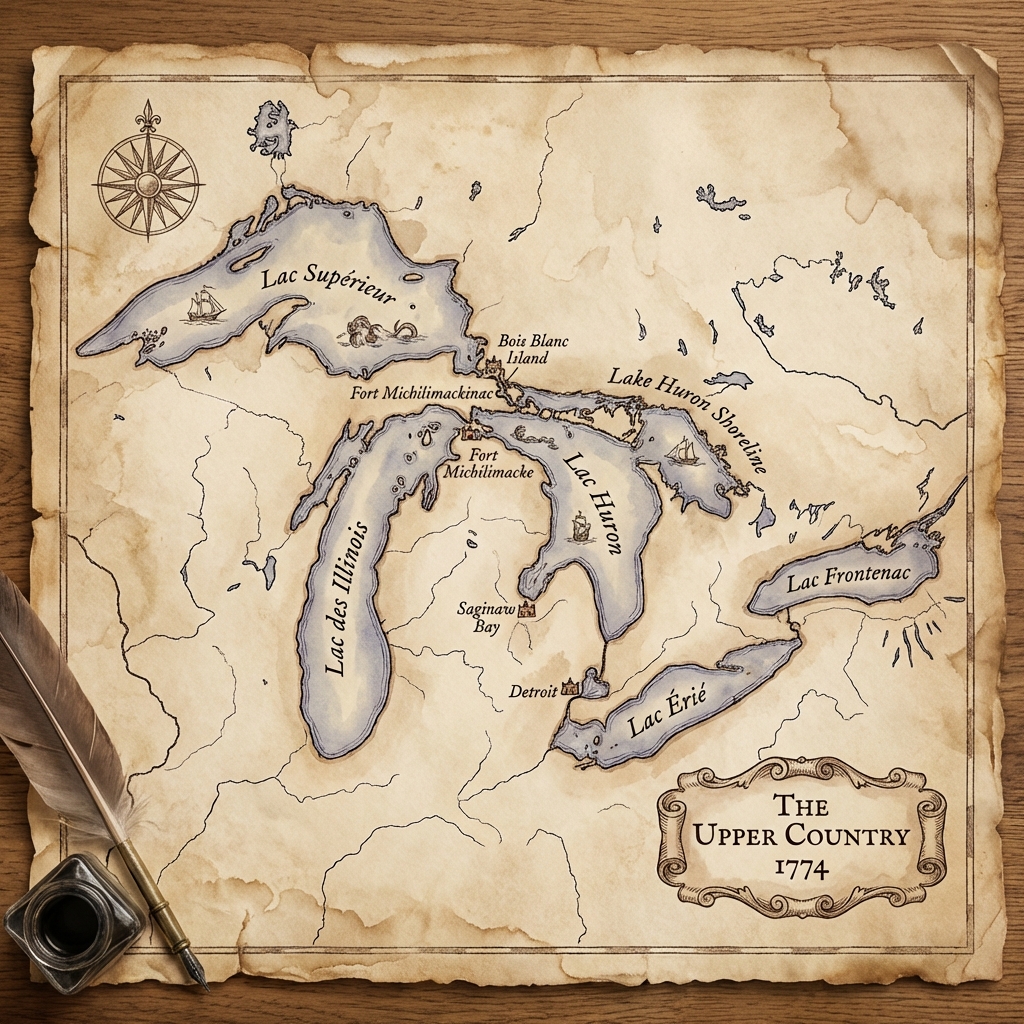
Samuel's journey from the Straits to Detroit.
Samuel's journey from the Straits to Detroit.
Mid-December 1774 — Detroit
The first thing Samuel noticed about returning to Detroit was how small it had become. Or how large he had. Either way, the city pressed wrong against him now—the streets too narrow, the fort’s shadow too familiar, the smell of soldiers and smoke and authority too thick to breathe cleanly.
He’d been in his small room at the church for three days, and Father Delisle had asked nothing except whether he’d eaten. The priest seemed to understand that some work happened in silence.
On the morning of the third day, Samuel began to notice the watchers.
Not obvious. Not soldiers. Just… presences. The habitant woman at the market who looked up when he passed, then looked away with intention. The boatman on the dock who called a greeting to someone else while Samuel was close enough to hear. The young clerk outside the trading post, doing nothing in particular, shifting his position when Samuel turned toward the river.
At first, he thought he was imagining it. Nerves, the weight of knowledge, the sense that carrying secrets made him visible. But by the afternoon of the third day, he was certain: someone was tracking his patterns.
The thought should have frightened him. Instead, it steadied something in his chest. They know I’m back. They’re deciding whether I’m worth meeting.
He began to move deliberately through the city. Not hiding, not fleeing—just present. He walked past the trading post where his father had kept accounts. He stood on the dock and watched the river. He attended Mass and sat in the back pew, listening to Father Delisle speak about obedience and faith. He moved through Detroit like he belonged to it, or it to him, as if he was someone the city needed to account for.
On the fourth day, the silver-haired man was standing outside the bakery.
Samuel recognized him instantly—that careful posture, the silver threading through dark hair, the way he held his shoulders like they carried weight he’d chosen. He was buying bread from the baker’s wife, speaking in French, his voice low and unremarkable. He looked like a merchant. Like everyone else. Like a man with no particular gravity.
Samuel kept walking. The baker’s wife wrapped his bread. The silver-haired man stepped aside to let a woman pass. For a moment—just a moment—his eyes found Samuel’s.
Not with surprise. With recognition.
Samuel turned left at the corner. The silver-haired man turned left at the corner. They walked in parallel paths that converged at the edge of the colonial district, where the streets opened toward the river and fewer eyes moved between buildings.
“Walk with me,” the silver-haired man said quietly. Not an invitation. Not a command. A statement of fact.
They walked past the dock where Samuel had stood yesterday. Past the warehouse where his father had conducted business. Toward a small chapel that Samuel hadn’t noticed before, tucked between two merchant houses.
“You went to Baptiste,” the man said.
“Yes.”
“You stayed nine days.”
“Yes.”
“You returned here three days ago and have spent that time… what? Observing us? Waiting?”
“Deciding,” Samuel said. “Whether I was ready.”
The silver-haired man smiled. It changed his face—made him older and younger at once. “And are you?”
They had reached the chapel. Its door was painted green, the paint peeling like old skin. No one was watching them anymore. Samuel realized that was intentional. They had moved through the city in a pattern that meant something to the people observing—a pattern that said: This is necessary. This is known. Let them pass.
“I need to report what I learned,” Samuel said.
“I know.”
“And I need to understand what my father was doing.”
“Yes.”
“And I need to know what it means to choose this.”
The silver-haired man opened the chapel door. Inside, it was dim and cool and empty except for candles burning in front of an icon Samuel didn’t recognize.
“Then we have much to discuss,” the man said. “But first—tell me what you learned on the shore. Not what Baptiste showed you. What you understood.”
Samuel stepped into the chapel. The door closed behind him with a soft sound, like permission being sealed.
The chapel was colder than it should have been. Samuel realized, standing in the dimness while the silver-haired man closed the door, that the cold was intentional—a place designed to keep men sharp, to make comfort impossible. There were no pews, just stone floor and three candles burning in front of an icon he didn’t recognize. A figure that might have been a saint or might have been something older, holding something that caught the candlelight like promise or warning.
“Sit,” the silver-haired man said, gesturing to the stone steps before the icon.
Samuel sat. His legs were shaking slightly, and he was grateful for the excuse to hide it.
The man didn’t sit. He stood, the candlelight making his silver hair look like it was burning.
“Tell me about the shore network,” he said.
So Samuel told him. Not everything—some things existed in the space between words, Baptiste’s lessons that couldn’t be translated into speech without breaking them. But the shape of it: the weir and the fish, the habitant farmer and his hidden pelts, the Wyandot women and their careful exchanges. The voyageurs singing old songs. The way information moved without paper, the way debts were tracked in memory, the way trust was the currency that mattered.
The silver-haired man listened without interrupting. When Samuel finished, the man was quiet for a moment.
“Who are the key players?” he asked. “The ones who move goods. The ones who connect to other networks.”
Samuel hesitated. This was the first test, and he knew it.
“I can’t give you names,” he said carefully. “Baptiste was clear about that. Written things—”
“I’m not asking you to write anything. I’m asking you to tell me. Man to man. No paper, no record. Just your word.”
It was a reasonable request. It was also exactly what Baptiste had warned against. The difference between speaking and documenting was thinner than Samuel had understood until this moment.
“I need to think about that,” Samuel said.
The man’s expression didn’t change. “You need to think about loyalty or you need to think about security?”
“Both.”
“Good. That’s the right answer.” The man moved closer. “But you also need to understand what you’re refusing. If we don’t know the network’s structure, we can’t protect it. We can’t coordinate with it. We can’t ensure that when pressure comes—and pressure will come—we respond in ways that don’t destroy what your parents died building.”
Samuel felt his chest tighten. Your parents died building.
“Tell me about my father,” he said.
“Not yet. First, answer my questions.”
“How do I know you’re not Crown?”
The man smiled slightly. “You don’t. But Crown wouldn’t bother asking. Crown would arrest Baptiste, torture him until he talked, then arrest everyone he named. Crown doesn’t negotiate with seventeen-year-old boys in chapels. Crown takes what it wants.” He paused. “I’m asking because the network matters. Because Baptiste’s work matters. Because your father’s work isn’t finished.”
Samuel’s hands were fisted. He consciously unclenched them.
“Ask your questions,” he said. “And I’ll answer what I can.”
What followed was methodical. Surgical. The silver-haired man didn’t demand details; he asked for them specifically. One at a time. Each question building on the last.
“The habitant farmer—does he connect to other networks or only Baptiste?”
“I don’t know.”
“The Wyandot women—do they come from a specific village or do they trade between multiple communities?”
“I don’t know.”
“The voyageurs heading north—did they mention destinations or just general direction?”
Samuel answered what he could. He described people without naming them. He traced routes without mapping them. He gave the silver-haired man shape without structure, understanding without architecture.
And with each answer, he felt the man evaluating him. Not his knowledge, but his discipline. His willingness to speak and his willingness to stop at certain lines.
Then the man asked: “There’s a woman. Marie, you said. At a waystation. She has books?”
Samuel’s breath caught.
“Medical texts,” Samuel said carefully. “Hidden.”
“Where?”
“I can’t—”
“She’s in danger,” the man said quietly. “There’s increased searching. Dumont’s camp is marked. Within a month, British will find that waystation. If we know where the books are, we can move them. Preserve them. If you don’t tell me, they burn with everything else.”
Samuel stood up. He couldn’t stay seated with this pressure bearing down on him.
“You’re asking me to trade Baptiste’s trust for—what? A maybe?”
“I’m asking you to make a choice between two forms of loyalty. Loyalty to the person or loyalty to the work. They’re not always the same thing.”
The chapel was very quiet. Samuel could hear the candles burning, the wind outside, the sound of his own breathing.
“If I tell you,” Samuel said, “then Marie becomes responsible. And Dumont. And everyone connected to that place becomes exposed if things go wrong.”
“Yes.”
“Then I won’t tell you.”
The words came out steady, and Samuel was surprised by that. He’d expected his voice to break.
The silver-haired man studied him for a long moment. Then he nodded.
“Sit back down.”
Samuel sat.
“Your father asked me the same thing once,” the man said. “I wanted him to document the network—create a ledger of safe houses, routes, key people. For protection, I said. For coordination. He refused. He said the same thing you just said—that writing it down made people vulnerable.”
Samuel’s heart was hammering.
“I was angry. I thought he was being sentimental. I thought he didn’t understand the stakes.” The man moved to one of the candles, adjusted its position slightly. “But he was right. And I was wrong. The network survived because your father refused to write it down. Because information stayed in memory, in relationship, in the spaces the Crown couldn’t reach.”
“Is that why he died?” Samuel asked. “Because of what he refused to document?”
“No. He died because Sergeant Wray was a sadist and your father kept honest books. Those are separate things that happened to collide.” The man turned back to face Samuel. “But I think your father would have been proud of what you just did. Refusing me. Choosing the network over expedience. That’s the craft’s true work.”
Samuel didn’t trust his voice, so he waited.
“Your father was being trained as I’m training you now,” the man continued. “Slowly. Carefully. He was learning that sometimes the most powerful thing you can do is refuse. Not in defiance, but in discipline. He understood—was beginning to understand—that the Crown’s power comes from documentation. From records. From paper that proves ownership and control. We survive by becoming unmappable. By existing in the spaces between written law.”
“My mother too?”
“Your mother perhaps more than your father. She understood that a ledger kept in heat-activated ink was a form of resistance. That knowing when to write and when not to write was the deepest craft.” The man paused. “The Crown killed them for other reasons—for Wray’s violence, for your father’s honesty. But they were valuable to us because they understood what you’re beginning to understand: that some things are stronger when they’re not written down.”

Samuel thought of his mother’s hands on the ledger. His father’s careful accounts. The compasses and square burned into that ring.
“What happens now?” Samuel asked.
“Now you study. Books. Ledgers. Ways of writing that only certain people can read. You learn the marks—the language carved into doorframes and bridges that mean safe or danger or watch for betrayal. You learn that the craft’s real power isn’t in what we say. It’s in what we don’t say. It’s in the spaces between words where memory lives.”
The man moved closer. “In two weeks, Wilkens will come to the church. He’ll teach you the practical network—routes, safe houses, how to move without being seen. But that comes after you’ve proven you understand the ethics. After you’ve shown that you can refuse even when you want to break.”
“I almost broke,” Samuel said quietly.
“I know. That’s exactly right. You need to feel the breaking point. You need to understand what it costs to hold firm. Otherwise, the discipline is just words.”
The man extended his hand. Samuel took it, and the grip was firm, evaluative, accepting.
“Welcome to the craft, Samuel Dunlap,” the man said. “Your father would have been proud. I’m proud, and I barely know you. That’s how you know you made the right choice.”
They spent another hour in the small chapel that Samuel hadn’t noticed before, and the man—still unnamed, still careful—taught Samuel the basics of the marks. How to read them in wood, in stone, in the weathered corners of buildings. How each symbol meant something, but only if you knew the language. How a mark that looked like natural wear to a Crown soldier meant shelter here or trust this family or danger approaching.
It was a language of refugees and resistance, of people who’d learned that permanence came not from fortification but from invisibility.
By the time they left the chapel, the sun had set completely, and Samuel felt scoured clean by the experience. Exhausted in a way that had nothing to do with physical tiredness.
The silver-haired man walked him back toward the church without speaking. At the corner where they’d met hours earlier, he stopped.
“There’s a package waiting for you with Father Delisle,” he said. “Books. Ledgers. Ways of writing that only certain people can read. Study them. Memorize them. Become fluent in them. In two weeks, Wilkens will come. Until then, you speak to no one about what we’ve discussed. Not even Father Delisle, though he knows the broad shape of things.”
“I understand.”
“Do you?” The man studied him. “Your father thought he understood many things. He was wise enough to keep learning even when he thought he’d mastered something. Don’t make the mistake of thinking understanding is final. It’s always incomplete. Always requiring more work.”
“What was my father learning when he died?”
The man was quiet for a moment. “How to forgive the Crown for being what it is. How to build instead of rage. How to accept that justice comes slowly, if it comes at all, and that sometimes survival is enough.” He paused. “He was nearly there. He would have been a great Builder, Samuel. I think you will be too.”
He turned and disappeared into the city’s darkness, leaving Samuel standing on the corner with the weight of choice settling on him like stones in his pockets—heavy, necessary, the kind of weight that kept you from floating away.
At the church, Father Delisle handed him the leather satchel without comment. Inside were three ledgers, blank except for symbols on the first page of each. The marks Samuel had just begun to learn how to read.
And in the first one, in his father’s careful handwriting, one sentence:
The measure of a man is not what he builds but what he refuses to break.
Samuel sat on his narrow bed, the satchel beside him, Baptiste’s note and his father’s message and Marie’s knife all arranged like relics of a shrine he was constructing in his own chest.
He opened the second ledger. This one had his mother’s handwriting—he recognized it from the household accounts she’d kept at the Straits, before the inspection, before blood on clean boards.
The page wasn’t empty. It was covered in small, precise marks. Marks that looked like handwriting unless you knew they were something else. Letters that meant nothing unless you knew the language. She’d been teaching herself the craft’s symbols, Samuel realized. She’d been learning to write in ways the Crown couldn’t read.
At the bottom of the page, a note in regular script:
For when you’re ready to speak without words.
Samuel ran his finger over the marks, trying to decode them. He couldn’t yet. But he would. That was the work ahead.
The third ledger was different. Older paper, the leather worn soft by use. He opened it carefully, afraid of tearing something irreplaceable.
The pages were filled with entries in his father’s handwriting, but they weren’t accounts. They were observations. Notes on people met along the shore. Routes remembered. Safe houses discovered. Weather patterns. The behavior of ice. The seasonal movement of birds. A thousand small details recorded with the same precision his father had once used for transaction ledgers.
But mixed between these observations were other entries, written in the heat-activated ink Samuel’s mother had taught him to see. Invisible unless held near flame. He took a candle from Father Delisle’s table and carefully heated one page.
Words appeared: Wilkens is sound. Can be trusted with the northern routes. Beaudry moves goods without asking questions. The French families remember what we are. And then, in darker ink, underlined: Baptiste knows the truth. When the time comes, he will do what needs doing.
Samuel’s hands were shaking as he turned the pages. Page after page of his father’s double life. The ledgers kept for Crown, meticulous and meaningless. The observations kept for himself, records that looked like contemplation. And underneath, in invisible ink, the real work. The network his father had been mapping not for documentation but for understanding. For memory.
Near the back, a longer entry, dated six months before the inspection:
Samuel is old enough now. He needs to begin understanding that the world contains orders beneath the Crown’s orders. That there are men—and women, God help them—who are building alternatives in the spaces the law can’t reach. If something happens to me, if the inspection comes as I fear it will, I need him to know: this work matters more than I do. The network matters more than any single man. Tell him to find Baptiste. Tell him to listen. Tell him to choose the craft if he can.
Samuel had to stop reading. He couldn’t see the words clearly anymore, and when he rubbed his face, his hands came away wet.
His father had known. Had known it was coming. Had spent months preparing for the possibility that he wouldn’t survive to teach Samuel these lessons himself.
Samuel turned to the last page of the ledger. It was blank except for three words written in heat-activated ink:
I chose right.
He held it near the candle flame and watched the words appear and disappear as the heat moved across the page. I chose right. I chose right. I chose right.
And underneath, in barely visible script: May you choose the same.
Samuel didn’t sleep that night. He sat on his bed with the three ledgers spread before him, learning the craft’s language one symbol at a time. The marks his mother had practiced. The observations his father had recorded. The hidden messages underneath.
By dawn, he understood something he’d only intuited before: his parents hadn’t been foolish about the Crown. They hadn’t been naive or idealistic. They’d been deliberate. They’d chosen to keep honest books because that’s what the craft demanded. They’d chosen to carry the network in memory and observation rather than in written records because that’s what survival required. They’d died because Sergeant Wray was a sadist and the world was violent—but they’d died in the service of something larger than themselves.
That wasn’t tragedy. That was purpose.
Around noon, Father Delisle brought bread and fish. Samuel ate without tasting it, his attention still on the ledgers. The priest sat for a moment, watching him.
“You understand now,” Father Delisle said. It wasn’t a question.
“I’m beginning to.”
“Your father understood very late in his life. Your mother understood much earlier. I think you may understand earlier than either of them.” The priest paused. “That could be a gift or a burden. Perhaps both.”
“Why didn’t you tell me? When I first arrived?”
“Because some knowledge can’t be given. It has to be earned. Baptiste taught you what you needed to learn on the shore. The silver-haired man showed you what choosing means. The ledgers your parents left—they’re teaching you what inheritance means.” He stood to leave. “You had to walk the path to understand it. Telling you wouldn’t have worked.”
After he was gone, Samuel pulled out the ledger with Marie’s knife and turned to a fresh page. He’d been given these books to study, but they were also vessels for what came next. He began practicing the marks—the language that looked accidental unless you knew. He practiced his father’s handwriting. He practiced the symbols his mother had left.
And slowly, without consciously deciding to, he began writing entries of his own. Not accounts. Not reports to the Crown. But observations. The things he’d seen on the shore. The patterns in the network. The understanding that was still forming in him like ice forming on a river—gradual, then suddenly complete.
By evening, he’d filled twenty pages with marks that meant nothing to anyone but him. A private ledger. A record only visible when you knew what you were looking for. A way of writing that existed in the spaces between Crown authority and revolutionary declaration.
That was the craft. That was what his father had been building. That was what his mother had understood.
And that was what Samuel was beginning to become.
The next morning, he took the ledgers to the room behind the altar where Father Delisle kept the church’s records. There was a hiding place there—a loose stone in the wall—where important things were kept safe.
Samuel placed his own newly written ledger there, alongside his father’s and his mother’s. Three generations of observation. Three layers of understanding. All invisible to anyone who didn’t know how to look.
“They’re safe here,” Father Delisle said quietly from the doorway. “As safe as anything can be in a world like ours.”
“How long have you been part of the craft?” Samuel asked.
“Long enough to know that it survives because of people like your parents. Long enough to understand that the real revolution isn’t violent—it’s patient. It’s the refusal to let the Crown’s order be the only order.” The priest paused. “In two weeks, Wilkens will come. He’ll teach you the practical work. But the real work—the work your ledgers represent—that comes from inside. That comes from choosing, every day, to build instead of burn. To remember instead of document. To survive with integrity intact.”
Samuel nodded. He understood now what his choice in the chapel had really meant. Not just loyalty to Baptiste. Not just commitment to the craft. But acceptance of a slow, patient, invisible work that might never be recognized or celebrated. That might end in death, as it had for his parents. That mattered anyway.
He walked back to his small room and opened the window. Below, the city moved through its routines—soldiers on patrol, merchants opening stalls, the river carrying ice toward the lake. The normal violence of empire, the everyday tyranny of the Crown’s order.
And beneath it, invisible to most eyes, the network. Baptiste on the shore. Dumont in the forest. Marie hiding books. Father Delisle offering shelter. Wilkens preparing to teach. The silver-haired man watching patterns. Two-Fingers moving goods. Singing Crow reading the seasons.
All of them building what couldn’t be seized. All of them choosing to measure twice and act once. All of them honoring an order deeper than the Crown’s, older than nations, rooted in the craft’s simple truth: some things are stronger when they’re not written down.
Samuel pulled out a fresh page and began to write—not in invisible ink yet, just in regular script—the beginning of something. Not a report. Not an account. Just words:
Mid-December 1774. I am learning to speak in silence. I am learning that my parents’ death was not wasted. I am learning that the shore remembers everything, and so must I.
I choose the craft. Not because I fully understand it yet. But because in refusing to break, I felt something true. Something that will not break either.
This is the beginning of my work.
Outside, the winter wind carried the sound of the river, endlessly patient, endlessly moving toward whatever came next.
Inside, Samuel Dunlap sat at a narrow desk in a small room at a church in a British garrison town, and began his real education.
The boy who had left the Straits with a ledger pressed against his ribs was gone.
In his place was something new. Something being built. Something that would last.

Using the heat-activated ink the clerk had taught him, he began recording not transactions but transformations. His own, yes. But also the shore’s—that other country that existed alongside the British order, patient as ice, inevitable as spring.
Samuel thought of his mother’s hands on the ledger. His father’s careful accounts. The compass and square burned into that ring.
“What happens now?” Samuel asked.
“Now you study. Books. Ledgers. Ways of writing that only certain people can read. You learn the marks—the language carved into doorframes and bridges that mean safe or danger or watch for betrayal. You learn that the craft’s real power isn’t in what we say. It’s in what we don’t say. It’s in the spaces between words where memory lives.”
The man moved closer. “In two weeks, Wilkens will come to the church. He’ll teach you the practical network—routes, safe houses, how to move without being seen. But that comes after you’ve proven you understand the ethics. After you’ve shown that you can refuse even when you want to break.”
“I almost broke,” Samuel said quietly.
“I know. That’s exactly right. You need to feel the breaking point. You need to understand what it costs to hold firm. Otherwise, the discipline is just words.”
The man extended his hand. Samuel took it, and the grip was firm, evaluative, accepting.
“Welcome to the craft, Samuel Dunlap,” the man said. “Your father would have been proud. I’m proud, and I barely know you. That’s how you know you made the right choice.”
They spent another hour in the chapel, and the man—still unnamed, still careful—taught Samuel the basics of the marks. How to read them in wood, in stone, in the weathered corners of buildings. How each symbol meant something, but only if you knew the language. How a mark that looked like natural wear to a Crown soldier meant shelter here or trust this family or danger approaching.
It was a language of refugees and resistance, of people who’d learned that permanence came not from fortification but from invisibility.
By the time they left the chapel, the sun had set completely, and Samuel felt scoured clean by the experience. Exhausted in a way that had nothing to do with physical tiredness.
The silver-haired man walked him back toward the church without speaking. At the corner where they’d met hours earlier, he stopped.
“There’s a package waiting for you with Father Delisle,” he said. “Books. Ledgers. Ways of writing that only certain people can read. Study them. Memorize them. Become fluent in them. In two weeks, Wilkens will come. Until then, you speak to no one about what we’ve discussed. Not even Father Delisle, though he knows the broad shape of things.”
“I understand.”
“Do you?” The man studied him. “Your father thought he understood many things. He was wise enough to keep learning even when he thought he’d mastered something. Don’t make the mistake of thinking understanding is final. It’s always incomplete. Always requiring more work.”
“What was my father learning when he died?”
The man was quiet for a moment. “How to forgive the Crown for being what it is. How to build instead of rage. How to accept that justice comes slowly, if it comes at all, and that sometimes survival is enough.” He paused. “He was nearly there. He would have been a great Builder, Samuel. I think you will be too.”
He turned and disappeared into the city’s darkness, leaving Samuel standing on the corner with the weight of choice settling on him like stones in his pockets—heavy, necessary, the kind of weight that kept you from floating away.
At the church, Father Delisle handed him the leather satchel without comment. Inside were three ledgers, blank except for symbols on the first page of each. The marks Samuel had just begun to learn how to read.
And in the first one, in his father’s careful handwriting, one sentence:
The measure of a man is not what he builds but what he refuses to break.
Samuel sat on his narrow bed, the satchel beside him, Baptiste’s note and his father’s message and Marie’s knife all arranged like relics of a shrine he was constructing in his own chest.
He opened the second ledger. This one had his mother’s handwriting—he recognized it from the household accounts she’d kept at the Straits, before the inspection, before blood on clean boards.
The page wasn’t empty. It was covered in small, precise marks. Marks that looked like handwriting unless you knew they were something else. Letters that meant nothing unless you knew the language. She’d been teaching herself the craft’s symbols, Samuel realized. She’d been learning to write in ways the Crown couldn’t read.
At the bottom of the page, a note in regular script:
For when you’re ready to speak without words.
Samuel ran his finger over the marks, trying to decode them. He couldn’t yet. But he would. That was the work ahead.
The third ledger was different. Older paper, the leather worn soft by use. He opened it carefully, afraid of tearing something irreplaceable.
The pages were filled with entries in his father’s handwriting, but they weren’t accounts. They were observations. Notes on people met along the shore. Routes remembered. Safe houses discovered. Weather patterns. The behavior of ice. The seasonal movement of birds. A thousand small details recorded with the same precision his father had once used for transaction ledgers.
But mixed between these observations were other entries, written in the heat-activated ink Samuel’s mother had taught him to see. Invisible unless held near flame. He took a candle from Father Delisle’s table and carefully heated one page.
Words appeared: Wilkens is sound. Can be trusted with the northern routes. Beaudry moves goods without asking questions. The French families remember what we are. And then, in darker ink, underlined: Baptiste knows the truth. When the time comes, he will do what needs doing.
Samuel’s hands were shaking as he turned the pages. Page after page of his father’s double life. The ledgers kept for Crown, meticulous and meaningless. The observations kept for himself, records that looked like contemplation. And underneath, in invisible ink, the real work. The network his father had been mapping not for documentation but for understanding. For memory.
Near the back, a longer entry, dated six months before the inspection:
Samuel is old enough now. He needs to begin understanding that the world contains orders beneath the Crown’s orders. That there are men—and women, God help them—who are building alternatives in the spaces the law can’t reach. If something happens to me, if the inspection comes as I fear it will, I need him to know: this work matters more than I do. The network matters more than any single man. Tell him to find Baptiste. Tell him to listen. Tell him to choose the craft if he can.
Samuel had to stop reading. He couldn’t see the words clearly anymore, and when he rubbed his face, his hands came away wet.
His father had known. Had known it was coming. Had spent months preparing for the possibility that he wouldn’t survive to teach Samuel these lessons himself.
Samuel turned to the last page of the ledger. It was blank except for three words written in heat-activated ink:
I chose right.
He held it near the candle flame and watched the words appear and disappear as the heat moved across the page. I chose right. I chose right. I chose right.
And underneath, in barely visible script: May you choose the same.
Samuel didn’t sleep that night. He sat on his bed with the three ledgers spread before him, learning the craft’s language one symbol at a time. The marks his mother had practiced. The observations his father had recorded. The hidden messages underneath.
By dawn, he understood something he’d only intuited before: his parents hadn’t been foolish about the Crown. They hadn’t been naive or idealistic. They’d been deliberate. They’d chosen to keep honest books because that’s what the craft demanded. They’d chosen to carry the network in memory and observation rather than in written records because that’s what survival required. They’d died because Sergeant Wray was a sadist and the world was violent—but they’d died in the service of something larger than themselves.
That wasn’t tragedy. That was purpose.
Around noon, Father Delisle brought bread and fish. Samuel ate without tasting it, his attention still on the ledgers. The priest sat for a moment, watching him.
“You understand now,” Father Delisle said. It wasn’t a question.
“I’m beginning to.”
“Your father understood very late in his life. Your mother understood much earlier. I think you may understand earlier than either of them.” The priest paused. “That could be a gift or a burden. Perhaps both.”
“Why didn’t you tell me? When I first arrived?”
“Because some knowledge can’t be given. It has to be earned. Baptiste taught you what you needed to learn on the shore. The silver-haired man showed you what choosing means. The ledgers your parents left—they’re teaching you what inheritance means.” He stood to leave. “You had to walk the path to understand it. Telling you wouldn’t have worked.”
After he was gone, Samuel pulled out the ledger with Marie’s knife and turned to a fresh page. He’d been given these books to study, but they were also vessels for what came next. He began practicing the marks—the language that looked accidental unless you knew. He practiced his father’s handwriting. He practiced the symbols his mother had left.
And slowly, without consciously deciding to, he began writing entries of his own. Not accounts. Not reports to the Crown. But observations. The things he’d seen on the shore. The patterns in the network. The understanding that was still forming in him like ice forming on a river—gradual, then suddenly complete.
By evening, he’d filled twenty pages with marks that meant nothing to anyone but him. A private ledger. A record only visible when you knew what you were looking for. A way of writing that existed in the spaces between Crown authority and revolutionary declaration.
That was the craft. That was what his father had been building. That was what his mother had understood.
And that was what Samuel was beginning to become.
The next morning, he took the ledgers to the room behind the altar where Father Delisle kept the church’s records. There was a hiding place there—a loose stone in the wall—where important things were kept safe.
Samuel placed his own newly written ledger there, alongside his father’s and his mother’s. Three generations of observation. Three layers of understanding. All invisible to anyone who didn’t know how to look.
“They’re safe here,” Father Delisle said quietly from the doorway. “As safe as anything can be in a world like ours.”
“How long have you been part of the craft?” Samuel asked.
“Long enough to know that it survives because of people like your parents. Long enough to understand that the real revolution isn’t violent—it’s patient. It’s the refusal to let the Crown’s order be the only order.” The priest paused. “In two weeks, Wilkens will come. He’ll teach you the practical work. But the real work—the work your ledgers represent—that comes from inside. That comes from choosing, every day, to build instead of burn. To remember instead of document. To survive with integrity intact.”
Samuel nodded. He understood now what his choice in the chapel had really meant. Not just loyalty to Baptiste. Not just commitment to the craft. But acceptance of a slow, patient, invisible work that might never be recognized or celebrated. That might end in death, as it had for his parents. That mattered anyway.
He walked back to his small room and opened the window. Below, the city moved through its routines—soldiers on patrol, merchants opening stalls, the river carrying ice toward the lake. The normal violence of empire, the everyday tyranny of the Crown’s order.
And beneath it, invisible to most eyes, the network. Baptiste on the shore. Dumont in the forest. Marie hiding books. Father Delisle offering shelter. Wilkens preparing to teach. The silver-haired man watching patterns. Two-Fingers moving goods. Singing Crow reading the seasons.
All of them building what couldn’t be seized. All of them choosing to measure twice and act once. All of them honoring an order deeper than the Crown’s, older than nations, rooted in the craft’s simple truth: some things are stronger when they’re not written down.
Samuel pulled out a fresh page and began to write—not in invisible ink yet, just in regular script—the beginning of something. Not a report. Not an account. Just words:
Mid-December 1774. I am learning to speak in silence. I am learning that my parents’ death was not wasted. I am learning that the shore remembers everything, and so must I.
I choose the craft. Not because I fully understand it yet. But because in refusing to break, I felt something true. Something that will not break either.
This is the beginning of my work.
Outside, the winter wind carried the sound of the river, endlessly patient, endlessly moving toward whatever came next.
Inside, Samuel Dunlap sat at a narrow desk in a small room at a church in a British garrison town, and began his real education.
The boy who had left the Straits with a ledger pressed against his ribs was gone.
In his place was something new. Something being built. Something that would last.
☕ Enjoying this story?
 Buy Me a Coffee
Your support helps keep this serial going. Thank you for reading.
Early Freemasonry ("The Craft") arrived in North America primarily through British military lodges attached to regiments. However, it quickly spread among merchants, fur traders, and leading citizens. On the frontier, where formal law was weak and distance was vast, the shared oaths and symbols of the lodge provided a vital network of trust across national, religious, and linguistic lines.
For men operating in the grey areas of colonial commerce and early revolutionary activity, Masonic membership offered a means to identify potential allies, ensure fair dealing, and provide mutual aid when the Crown's authority was either absent or oppressive.
The use of "sympathetic inks" for covert communication was a sophisticated and necessary art during the Revolutionary era. While simple heat-activated inks like lemon juice, milk, or vinegar were common, more complex chemical inks (like those developed by James Jay for the Culper Ring) were highly prized.
In frontier ledger work, weaving these covert messages between mundane records of pelts and provisions allowed intelligence and names to move safely under the very eyes of British inspectors who were trained only to read the numbers.
In French-Canadian settlements like Detroit, the Catholic Church was often viewed with suspicion by the Protestant British authorities. While officially tolerated, local priests often found themselves balancing the spiritual needs of their occupied flock with the political demands of the Crown.
Sympathetic clergy like Father Delisle provided more than just spiritual comfort; the physical spaces of the church—crypts, back rooms, and hidden chapels—offered rare zones of privacy where resistance figures could meet, exchange information, and hide sensitive records away from military patrols.
Frontier garrison towns like Detroit operated under a state of constant, informal surveillance. The British military commanded the fort, but they relied heavily on local informants, allied Native Americans, and watchful loyalists to understand the undercurrents of the town.
Resistance networks countered this by developing their own counter-surveillance—learning to recognize the patterns of those watching them, using specific signals or "marks," and moving through the city with a deliberate, visible routine that intentionally meant nothing at all to an observer.