The Upper Country, 1774
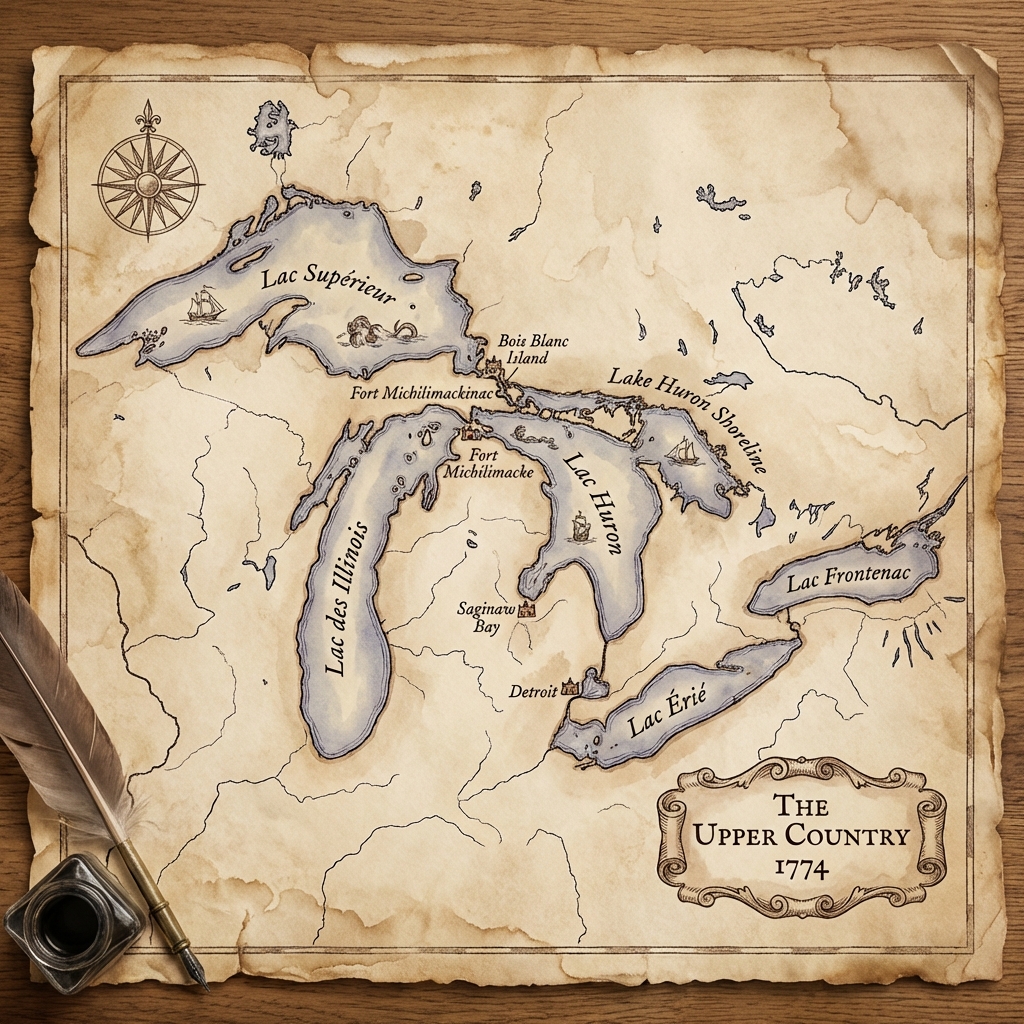
Samuel's journey from the Straits to Detroit.
Samuel's journey from the Straits to Detroit.
Late October 1774 — The willows above the creek
He kept to the ditch until the willow thinned, then slid into birch and popple where the frost still held in shade. The ledger rode flat and cold against his ribs. Every breath put the book there again.
At the creek he went in to the shin and let the water take the blood from his hands and cuffs. Rust clouded, ran off, was gone. He scrubbed until his skin burned. Wind dried him quick and mean.
Leather creaked somewhere upslope—tack, not branch. Voices skimmed the trees.
"…back to the Fort."
"That ledger—"
"Leave it, Harris."
He didn't breathe. The sound went down toward the shore and thinned. A jay scolded once and gave up. He crawled under a fallen pine and watched the path no one took.
North was the mission and the Fort. West was swamp. East was the island and big water. South was Detroit by way of luck. His luck felt thin.
His mother had promised bread to Dejean. Dejean liked bread and news the same. The voyageurs would make the point before noon.
He cut low through willow to the curl of sand, belly to the drift line, and looked out. A long canoe angled for the lee—three men, caps square, sashes bright as birds against the gray. The bow paddle went up once, held, and came down: landing.
He broke cover at a trot and met them at the knees. He had his hands to the gunwales before the hull kissed sand.
Dejean grinned, then saw Samuel's shirt and lost it. "By God. Where—"
"Not here," Samuel said. "Pull through."
They ran the canoe to the pocket behind the point where reeds made a screen. Lefevre and the Cheboygan boy dragged bow and stern; Dejean watched the open water. When the keel settled, Dejean's hand found Samuel's shoulder and came away stained.
"Whose?"
"Mine," Samuel lied, then shook his head. "Mam. Da."
Dejean swore softly, no show to it. "Soldats?"
"Wray," Samuel said. "A shove. A shot. They'll call it duty."
Lefevre looked sick. The boy crossed himself. The reeds hissed like they'd been told a secret.
"You cannot stay," Dejean said.
"They'll sweep the brush," Samuel said. "I need to be gone before they remember how."
"Bois Blanc," Dejean decided. "Lie up till dark. Then we cross in the Fort's lamps." He looked at Samuel's chest. "The book?"
Samuel put his palm flat where the oiled cloth pressed his skin. "Here."
Dejean dug a roll of oiled canvas from under the seat. "Wrap it. If you go over, you don't drown for paper." Samuel tied the knot high and flat. His breath went shallow against it. Dejean watched his hands and was satisfied.
"Bow," he said. "We slide out like thieves."
Samuel looked once toward the post but the word he needed—bury—wouldn't hold a shape. Dejean rested both hands on the paddle like a priest leaning on the rail.
"You come back proper," he said. "Not with Wray at your heels. We will put stones. Go."
The reeds let them go with a hush. The hull took the first chop and settled. The shore curved away; the point hid the house. The cold came on full.
Dejean set the stroke. Lefevre matched. The boy steered. Samuel knelt and watched the water by the bow. He told it, because telling was the only way the words would stop burning: rope stiff with ice, Wray's hat in his hand, Harris's sleeve against his mother's hip, the shove, the flash, the smoke, the kettle screaming. His mother saying his name and then "Ledger," like she was tying off the last knot.
When he finished, only water spoke.
"They will write it a riot," Lefevre said.
"Riot is what men call it when a house won't bow," Dejean said.
The island rose out of the pale. They slid along cedar roots to a black mouth in the brush and nosed into a pocket no wider than two canoes. It smelled of wet wood and old leaves. The wind died like a door closing.
"Out," Dejean said, quiet. He pointed under a tangle of cedar. "Lie there till night. If you hear two short and one long whistle, it's us. If you hear nothing and the light goes, it's still us when the Fort sleeps."
He put a stub of sausage and a heel of bread in Samuel's hand. "Eat. No thinking on an empty belly."
Samuel ate slow because the first mouthful woke a hurt. His hands shook; he laced his fingers and let it pass.
"You have someone at Detroit?" Dejean asked.
"Wilkens," Samuel said. "And a priest if Wilkens fails."
"There are men at the river who do not love red coats," Dejean said. "Some speak soft now. Some won't be quiet long."
He touched Samuel's shoulder once, quick and firm. "Sleep if you can. No smoke. No light. Piss in the sand, not the water."
Samuel nodded. "I'll be here."
The canoe backed out like a shadow. The cut closed. The pocket darkened a shade.
He crawled into the cedar hollow, set his back to a root, and pulled the oiled cloth tighter. He slept because the body took what it was owed.
When he woke, the light was the gray that lies about distance. Somewhere outside, wood knocked hull—deliberate. Two short whistles whispered. Then one long, soft as a bird call.
Dejean's bow slid in. His palm lifted: wait.
Voices carried over the outer water—English, official bored. "—didn't put in here."
"Not worth the look."
Tack jingled. A horse snorted. Oars creaked where he couldn't see. The sound thinned toward the channel. When it was gone, Dejean breathed again.
"Fort sent a yawl to nose the reeds," he murmured. "They like their show. Night will be better."
He leaned close. "If they stop us, you go over on my word. Swim for the point. The book floats. Let it carry you. Do not turn back."
"I won't leave you," Samuel said.
"You will," Dejean said, and there was no room in it. "I know this water. I don't need you to save me. I need you to keep what your mother put in your hand."
Samuel swallowed. The knot under his shirt pressed a small truth into his chest. He nodded once.
"Good. We go when the lamps make a road."
He was gone again. Samuel ate what was left and drank from his palm. He checked the knife he had taken from the counter—edge clean, no burr. He touched the ledger once and then made himself stop. A man shouldn't keep touching the same truth in a day.
Night came proper. Across the channel the Fort lamps pricked a thin line like embers dropped and left. Wind eased. A loon called somewhere downlake, torn and long.
The canoe nosed in a final time. "Now," Dejean whispered. "Quiet as prayer."
Samuel slid into the bow. The cut let them out. They ghosted along the island's dark edge and pushed into the channel, Fort lamps left, big water right.
"Hand on the thwart," Dejean breathed. "If we go over, do what you promised."
Samuel didn't answer. He looked forward where the water narrowed and the river's pull began. He breathed and the book moved with his chest. He heard his mother's last two words as if they came off the cold itself.
Order. Memory.
He set his jaw and let the canoe carry him south.
☕ Enjoying this story?
 Buy Me a Coffee
Your support helps keep this serial going. Thank you for reading.
The British military outpost at the Straits. After the violence at the trading post, Samuel knows the Fort means arrest—or worse. Wray and his men will report their version of events first.
The largest settlement in the region, roughly 280 miles south by water. Detroit was the hub of the fur trade and seat of British authority in the region. Samuel's partner Wilkens is based there.
The journey by canoe would take several days, following the lakes and rivers that connected the frontier.
French-Canadian canoe men who transported furs and trade goods across North America's waterways. They were legendary for their endurance and their role as cultural intermediaries.
Men like Dejean moved between worlds—French, British, Indigenous—with an ease that made them invaluable on the frontier.
The ceinture fléchée—a brightly colored woven sash worn by voyageurs. More than decoration, the sash served as a back brace during portages, a towline, and a mark of identity.
The distinctive arrow pattern and bright colors made voyageurs recognizable across the frontier.
"White Wood Island"—a small island in the Straits of Mackinac, just east of the mainland. Its dense cedar growth provided cover for those who knew where to look.
The island sat between the mainland and Mackinac Island, making it a useful waypoint for canoe travel through the Straits.
Samuel's father's business partner, based in Montreal or Detroit. Trading partnerships like Wilkens & Dunlap typically combined capital from established merchants with local knowledge from frontier traders.
With his father dead, Wilkens may be Samuel's best hope for protection—or his biggest liability.
British soldiers—and by extension, British authority. Dejean's comment hints at growing unrest: "Some speak soft now. Some won't be quiet long."
The American Revolution was months away from open warfare. On the frontier, many French-Canadians and traders had little love for their new British rulers.