The Upper Country, 1774
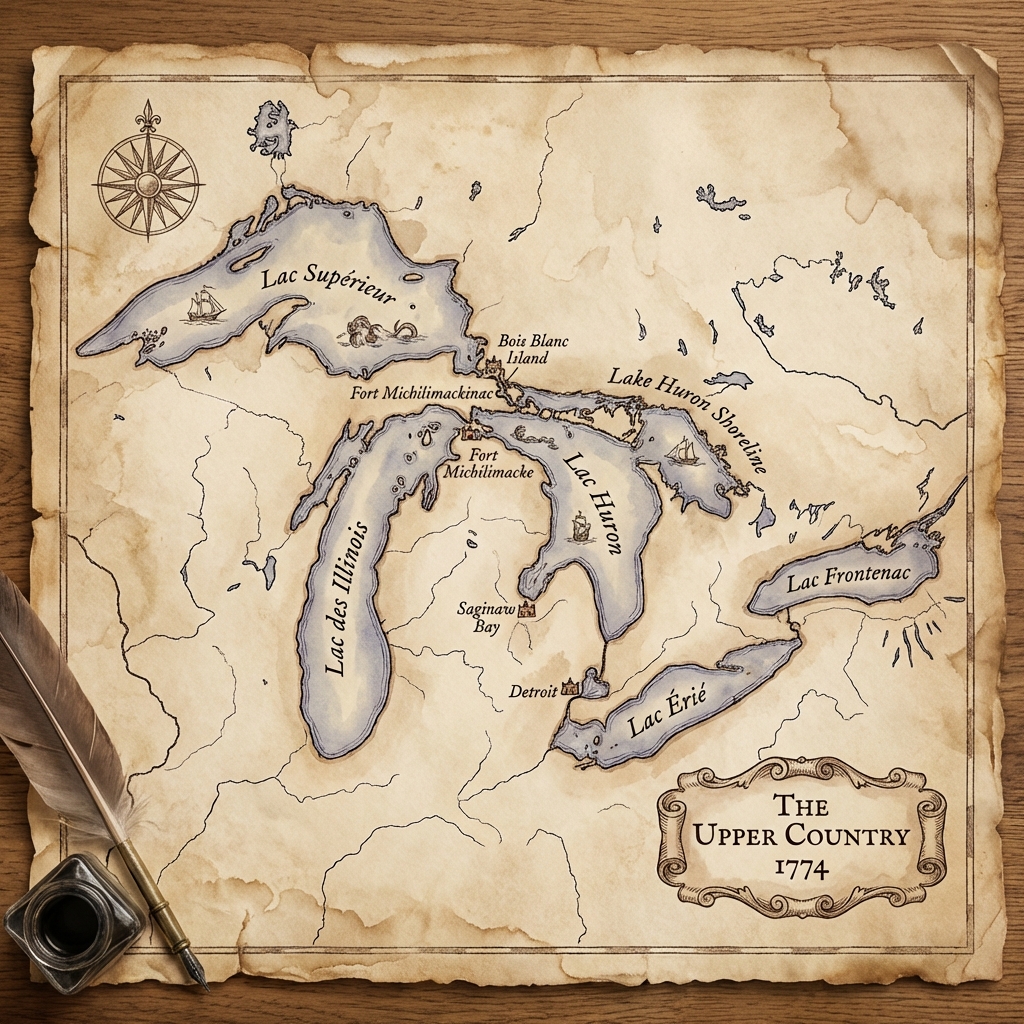
Samuel's journey from the Straits to Detroit.
Samuel's journey from the Straits to Detroit.
Fort Michilimackinac, 1774
Pursuant to the late Act enlarging the Province of Quebec and ordinances respecting customs, I did proceed with a file of men of the 8th Regiment of Foot to a trading house upon the Michigan shore opposite the strait, the same being kept under the style WILKENS & DUNLAP.
Found on the premises: bales of beaver and marten; one crate iron hoes (edges blued); one keg of wine alleged for priestly use; sundry cloth (blue stroud); gunflints; and other goods proper to the trade. Ledger neat, but imperfect as to the last entries. Proprietor DUNLAP obstinate in speech, denying the additional fee customary upon inspection; his wife present and active in business.
Note: the proprietor wore upon his right hand a ring of Compasses and Square, the same plainly shown while he set his mark to figures; the sign is much seen among traders in these parts. The woman likewise bore herself with an industry beyond her sex, which I remark only as to her uncommon authority in the house.
Resistance not open but provocative—language unbecoming toward His Majesty's servants. In the course of examination a scuffle arose by reason of the man touching the book too quick for our private HARRIS, whereupon order was restored with difficulty.
I have seized those parcels not entered and assessed duty upon the rest as example to others along the shore, this being the new practice under the Act. Recommend further notice be taken of said house; the woman in particular shows a spirit apt to excite the people.
— SGT. T. WRAY, 8th Regt. of Foot
☕ Enjoying this story?
 Buy Me a Coffee
Your support helps keep this serial going. Thank you for reading.
A British military outpost and trading center at the Straits of Mackinac, where Lake Michigan meets Lake Huron. In 1774, it was the gateway to the western fur trade and one of the most remote posts in British North America.
The population was overwhelmingly French-Canadian—roughly 80% of European inhabitants. British soldiers and officials formed a small minority, having taken control only eleven years earlier after the French and Indian War.
Passed by Parliament in June 1774, the Quebec Act formally incorporated the Great Lakes region into the Province of Quebec. It recognized French civil law and Catholic rights—pragmatic moves to secure French-Canadian loyalty.
The Act also imposed new customs regulations on the fur trade. In the Thirteen Colonies, it was denounced as one of the "Intolerable Acts." Within months, the American Revolution would begin.
The King's Regiment, a British Army infantry unit garrisoned at frontier posts including Michilimackinac. Soldiers like Sergeant Wray enforced customs regulations, maintained order, and represented Crown authority in territories where actual British control was tenuous at best.
The regiment would later fight in the American Revolution, defending British interests in the Great Lakes region.
The southern shore of the Straits of Mackinac, in present-day Mackinaw City, Michigan. Trading posts clustered here, strategically positioned where Lake Michigan meets Lake Huron.
Despite European claims, this territory remained under the practical control of Indigenous nations—the Ojibwe, Ottawa, and Potawatomi (the Three Fires Confederacy). Traders operated only with their permission, often through kinship ties formed by marriage.
A trading partnership operating at the Straits. Such partnerships were common—combining capital, connections, and labor to manage the complex logistics of the fur trade.
The Dunlap name suggests Scottish or Scots-Irish origins, common among frontier traders who sought opportunity where their outsider status mattered less than skill and endurance.
Beaver and marten pelts were the economic engine of the frontier. European hatmakers prized beaver fur for felt, while marten (a type of weasel) provided luxury trim. A single prime beaver pelt might trade for goods worth a week's wages in Europe.
The trade depended entirely on Indigenous hunters and their knowledge of the land. European traders were middlemen, exchanging manufactured goods for furs that Native communities harvested.
A coarse woolen cloth manufactured in Stroud, England, specifically for the North American trade. Blue and red stroud were highly valued by Indigenous communities for clothing and blankets.
Trade cloth was among the most important goods exchanged for furs—alongside iron tools, weapons, gunpowder, and alcohol.
The Square and Compasses—the emblem of Freemasonry. Masonic lodges were widespread among Scottish and colonial traders, merchants, and military officers in the 18th century.
Membership provided a network of mutual recognition and trust across vast distances—useful for men doing business far from courts and contracts. Sergeant Wray's note suggests both recognition of the symbol and perhaps suspicion of the brotherhood it represented.
Britain had controlled these former French territories for just eleven years, since the Treaty of Paris ended the French and Indian War in 1763. Their hold remained tenuous—Pontiac's War (1763-1766) had shown how quickly Indigenous nations could challenge European power.
British soldiers garrisoned the forts, but French-Canadians ran the actual economy. There was no American colonial presence here yet—the Revolutionary War hadn't begun, and actual American settlement wouldn't reach Michigan until the 1820s.