The Upper Country, 1774
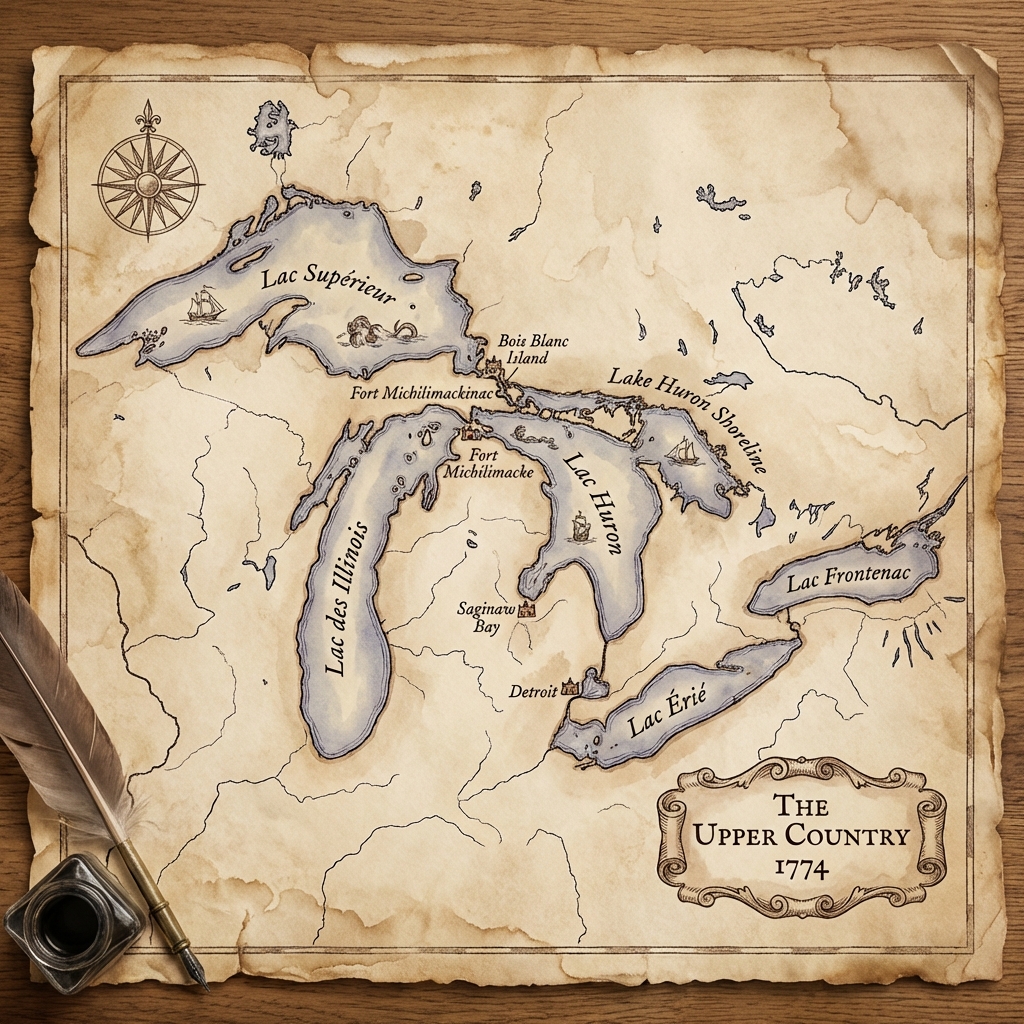
Samuel's journey from the Straits to Detroit.
Samuel's journey from the Straits to Detroit.
Early December 1774 — Detroit
The bells at Ste. Anne's shook the thin light loose from the river. Father Delisle's hand woke Samuel before they finished tolling. It was a touch to the shoulder, two strokes, nothing more.
"Bread at the hearth," the priest said. "One piece for your pocket, one for your mouth. Walk out by the yard gate. If a soldier asks why you're here, you brought wood for the stove and left when the work was done."
Samuel sat up on the pallet, the beeswax smell of the vestry still in his head. The ledger pressed a familiar corner against his ribs. Hunger answered at the word bread like a dog to its name.
At the hearth a round loaf had been cut into patient wedges. He took two. The first stayed whole and went under his coat; the second he divided with his thumb and teeth, made himself chew slow so his stomach wouldn't shame him. The crust tasted of ash and grace.
"Eyes first," Delisle said, passing a small rosary bead on a thread, the cross broken away long ago. "If you drop this and kneel to pick it, you are only a pious boy with clumsy fingers."
Samuel slid the bead into his pocket with the char sliver and the notched stick. Three small truths, none of them the ledger.
"Go," the priest said. "Return by the alley at noon if you can. If you cannot, then don't, and I will assume you learned something important or something dangerous."
The yard gate let him out to the chill. A blue smoke lay on the streets, low, as if men had been careful with their fires and the day hadn't yet decided to scold them for it. Detroit's morning had a rhythm—barrels rolled, dogs argued, a woman called a child by both names so he'd know she meant it. From the palisade, a drummer marked nothing in particular just to remind people that someone could.
He took the lane that would have made him invisible if anyone cared to see, and put himself where the silver-haired man had told him: where he could watch two corners with one turn of his head and three doors with a blink. The river lay a block away, a long gray idea behind houses.
He began counting the way he'd been taught—without numbers on his face, only the tick of a finger against his thumb inside his coat. People first. Men with hats set like they owned them, men with hats held in their hands, a boy running, two girls carrying a basket too heavy for either alone. Soldiers in twos. The apple-seller at the gate had not yet set up; his absence was a note of its own.
At the lower wharf the show had begun. A yawl from the Fort nosed a trader's canoe away from a landing with a shove that was too polite to be honest. The red coat in the bow called for manifests and made the word sound like a punishment. A corporal on the dock—no lace, the authority in his mouth—took a note from a man who had the look of one who had been made to produce the same note yesterday and would be made to produce it again tomorrow.
Samuel let the scene pass through him and kept the counts the way he kept a prayer—quiet, steady, exact where it mattered. Bateau: three, then a barge with a new-built box nailed to its deck that meant contraband or ingenuity or both. Men on the box's lid treated it like it had splinters that would complain to authority if rubbed wrong.
He walked as the silver-haired man had asked—no one spoken to first, no one answered who caught him with their eyes. Twice he lifted the broken rosary bead with numb fingers and let it fall again in the muck, kneeling to retrieve it while he made the sums neat in his head and fixed each to a picture: the man with the twisted ear; the lashings set wrong; the barrel with a second bottom hastily re-pegged. He spoke the picture to himself under his breath and the picture turned to a word and the word took a number and stayed.
He ate the second half of his slice when he passed the cooper's stall, putting his back to the smell of wet oak staves so the hunger would not make a memory of it.
At mid-morning the Fort's yawl tired of politeness. The crew swung a crate with a rope sling and jogged it on purpose so the lid gapped and the crowd saw blue cloth where flour should have been. A murmur ran. Two women crossed themselves; a soldier laughed like a man who does not know when laughter goes bad.
The merchant protested in both French and English, both languages saying the same thing: the cloth had been paper yesterday; the duty had been different last week; the river had its own rules and the river had not been consulted. The corporal called for the sergeant with the better hat. The sergeant did not come. Power came slow when it wanted to be seen arriving.
Samuel slipped upriver a block and let himself be swallowed by the market noise. Men argued over the price of onions like onions were gold. A fiddler tried to play and failed until his fingers remembered why they had asked for a bow instead of a hammer when he was ten. An Oneida woman sold combs and kept her mouth in a line that said she knew every word around her and would honor none that did not deserve it.
The apple boy appeared as if conjured—thin, faced with freckles made by a sky that liked him, a basket wider than his chest. His cry was not loud; it was placed. "Apples, sweet as church," he said. "Apples, red as your first sin." He ran into Samuel at the corner by accident that wasn't.
"Buy one for your priest," the boy said without moving his lips.
Samuel put a coin in the basket and took two apples without speaking.
"Back gate at the hour they water the goats," the boy said to the street, to a dog, to the sky—anyone but Samuel. Then he was gone, the cry moving with him down the lane like a string pulling it.
Samuel kept counting.
He found crates that weren't crates stacked by a cooper's shed—tight grain, wrong weight; the sound when tapped with a knuckle went too high. He watched a woman slip an extra loaf to a man he didn't belong to and wondered which law he was meant to respect. He tracked a messenger in the Indian Department's green coat, counted the papers the man kept close against his chest, judged how fast a runner he was by the places his shoes had split. He named him Soft Knee and put a three to him—three messages, enough to matter, not enough to prove a pattern yet.
He did not go near W. & Co. Instead he made a long curve that put him by the palisade gate in time to see a file of soldiers come back from the countryside. Mud to mid-calf. One had a sack that dripped grain like a poor man's hourglass. Another carried a pewter cup on a thong around his neck as if he'd won it the night before in cards and was trying to make the day admit it was still his.
Behind them, a farmer walked with his hands empty. He did not shout. He did not cry. He had a face like a wet field—no expression until the sun made it shine. Two boys stepped out from a doorway and looked at him like he might be the first verse of something they had yet to learn.
The youngest soldier, not yet smart enough to be careful, kicked a dog because the dog barked. The dog yelped and scattered hens like thoughts. The officer behind them—a lieutenant, sword more polish than steel—did not rebuke, did not praise. He scratched at his lace with a forefinger and admired his own coat in a window that did not wish to see him.
Samuel let his breath settle and made himself stand as a boy with an errand stands when soldiers pass—still, not curious, a piece of furniture that could walk if asked. One of the privates—older, mouth hollow where two teeth were gone—noticed him anyway. His eyes went to Samuel's hands and then to the small rise under Samuel's coat where the ledger lay. Had he looked longer, the day would have changed. He didn't. Hunger pulled him toward the stew pots farther down the lane and he obeyed that officer instead.
When the goats were watered—the street's small flood rinsing dirt and news to the drains—Samuel took the alley beside the seamstress. A hand like a fishhook caught his sleeve and brought him flat into the darkness.
"Count," said a voice that was not the clerk's and not the silver-haired man's. The apple boy. "Say it once. If I tell you to stop, you stop in the middle of a word and that word is the one I carry."
Samuel did as told. "Three bateaux in tow," he said, voice low. "One barge with a box built proud to hide its shame; lashings poor. Fort yawl showing cloth in a flour crate—public lesson. Merchants angry enough to make mistakes. One messenger in green, Soft Knee, three packets. Soldiers back from the farms—grain that was not theirs, a new pewter cup that belongs to a tavern on St. Louis Street by the dent on its rim, the lieutenant with an itch for his lace. Two crates that aren't crates by the cooper, pitched high when knocked. A woman who loves order enough to break it for a man who needed bread."
"Names," the boy said.
"No names spoken to me first," Samuel said. "Faces I can find again."
"Good," the boy said, businesslike. "Two more."
"Ships upriver," Samuel said. "A sloop showing a new coat of paint where its name would be; hiding its own name is a kind of confession. The men who carry apples for the fort's kitchen are lighter by one; one of their sacks is now flour and not apples—traded along the lane, compensated in coin I couldn't see."
"And the last?" the boy said.
Samuel hesitated. The day placed the weight of an answer in his mouth. "A man," he said. "Older. He has a scar like a bent nail at the corner of his lip. He looks like he knows the price of a lie and there's no bargain he won't try once. He watched the Fort yawl and counted different than I counted. He's counting people."
"And you didn't speak to him," the boy said, satisfied.
"I did not."
"Good," the boy said again, and the word held an older man behind it. "You'll go to the alley behind W. & Co. now. Tap twice and once. If a woman answers and tells you to fetch a comb you'll go buy a comb and do not come back for an hour. If the door opens and no one speaks, walk in."
"What if a man answers?" Samuel asked.
"Then you're in the wrong alley," the boy said, and was gone, his basket already crying the next corner sweet.
Samuel found the alley. He tapped twice and once. The door opened a palm's width—no breath, no words—and widened enough for him to pass. The clerk closed it at his back with a quiet he'd practiced.
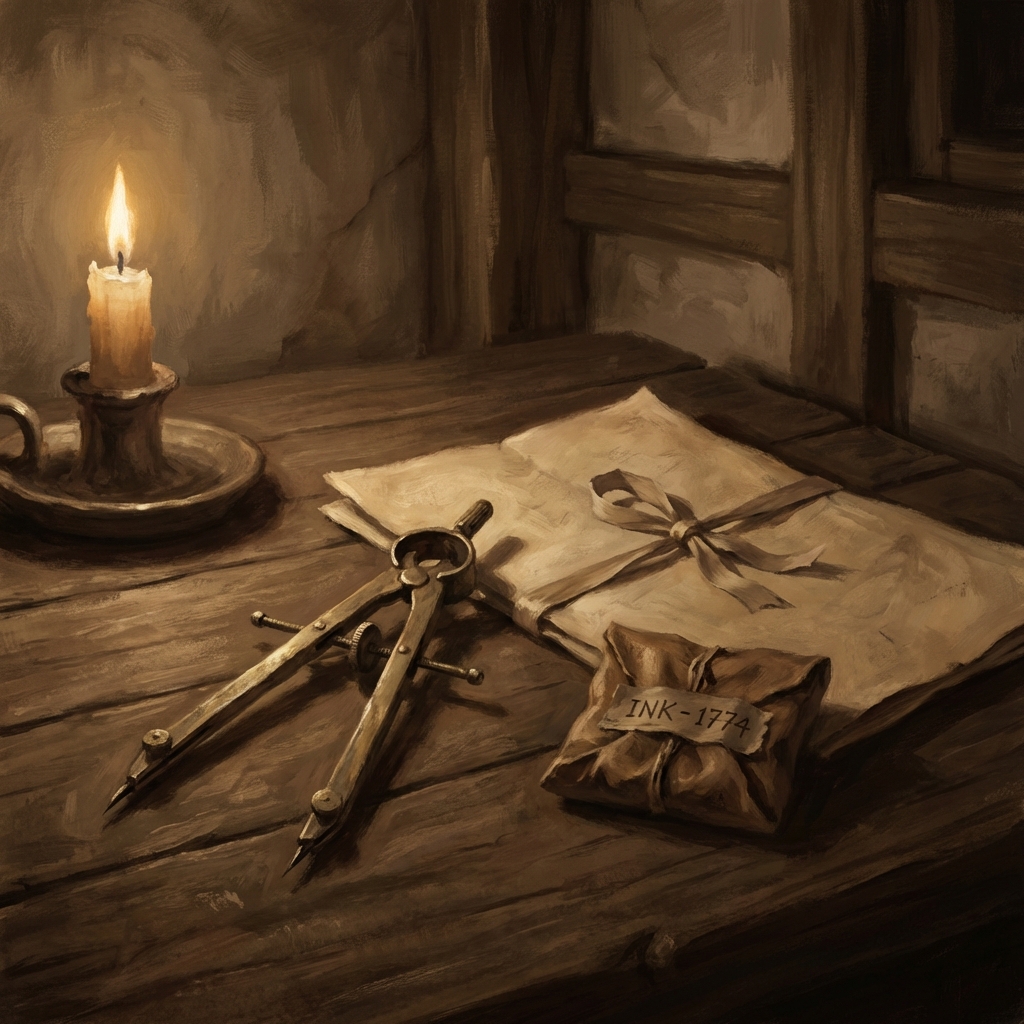
The compasses rested on the table—symbol of a brotherhood older than any empire.
"Speak," the clerk said, already setting the compasses on the table as if to weigh the room.
Samuel spoke the day—pictures to words, words to counts, counts to the shape of a river that wanted to be a ledger and sometimes succeeded. The silver-haired man came in halfway through and did not interrupt. When Samuel reached the pewter cup, the man's mouth moved like he had recognized a friend with a new shirt.
"The man with the scar?" he asked when Samuel finished.
"I can find him," Samuel said.
"You will not," the silver-haired man said. "Not today. He is one of ours when he behaves. Today I cannot promise his behavior." He tapped the compasses' hinge and they opened to a new angle. "And the box on the barge?"
"Tools by the manifest," Samuel said. "By weight, iron and air in the wrong proportion. By the way men looked at it—hope."
The silver-haired man allowed the smallest nod. "You learn quickly."
The clerk slid a sheet across the table, blank, save a line of neat figures at the bottom—nonsense sums meant for someone else's eyes if need be. He set the iron-gall packet by Samuel's hand. "One line," he said. "One word for each thing you would not forget if the day turned bad. Heat later, and the letters rise. If you are stopped now there is only a boy's scratch with numbers that add to nothing."
Samuel bent and made his line—scar; Soft Knee; green box; flour/cloth; pewter dent left; apple short; sloop paint new; birch tongue (for the ford tomorrow, a note to himself he could not say aloud). The pen scratched like a small animal trying to escape and then went still.
The clerk folded the paper tight, slid it into a cheap bill-head for nails and salt, and tied a thread. "Beaudry will read it," he said. "If the Fort interferes, he will swallow it and spit it later in the river where we know to look."
The silver-haired man studied Samuel the way a man studies a beam he means to build on. "There is more to do," he said. "Less watching, more carrying. A warehouse by the river—old planks, new lock. Tonight you will test the lock and fail. Tomorrow afternoon you will succeed."
"I've never opened a lock," Samuel said.
"That is why you fail tonight," the man said, almost a smile. "We will teach you to fail quietly. It is a skill most men neglect."
The clerk pushed a heel of bread and a strip of dried apple across the table with two fingers, as if pushing coin. "Eat where no one sees you," he said. "Hunger makes eyes greedy. Then go back to the church and put your face in a book until a sergeant believes you cannot be a danger because you look like you're doing something that frightens him."
Samuel took the food, and the bill-head, and the praise he pretended not to hear because praise can turn a man foolish. At the door, the silver-haired man stopped him with a hand that weighed no more than the rosary bead.
"Order is memory," he said.
"I remember," Samuel said.
"Good," the man replied. "Because men who will call this order will try to make you forget."
Outside, the day had sharpened and gone mean. The Fort's drummer found a purpose—parade or punishment. A woman argued with a customs man and lost. Across the lane, two soldiers laughed at a cripple whose crutch had slipped on a turnip.
Samuel made himself small and plain and threaded through it until Ste. Anne's welcomed him with its old wood and quiet. He set himself on a bench with a book he did not read, let his eyes run the letters the way a man runs a shore with his hand on the gunwale. The ledger pressed steady against his ribs like a promise kept under a coat—heavy, present, patient.
When evening came and the bell tolled, Father Delisle put a finger on the page Samuel had not turned for an hour. "Your day?"
"Counted," Samuel said.
"Good," the priest said. "Tonight, you will try at failing. Tomorrow, you will try at succeeding. And if God is kind, you will learn to tell the difference before men do."
He ate the last of his wedge when the light went. He put the broken bead between finger and thumb and remembered each picture until it settled into the place pictures go when they've earned it. The black wood splinter in his pocket left a faint smear on his skin. He didn't wipe it off.
Outside, the river turned dark and went on carrying what men asked of it—grain and cloth, hope and lies, orders and the memory that argued with them.
Samuel stood when he was told, and went to learn how to fail.
☕ Enjoying this story?
 Buy Me a Coffee
Your support helps keep this serial going. Thank you for reading.
The largest European settlement in the Great Lakes region, with a population of roughly 1,500. Founded by the French in 1701, Detroit had been under British control since 1760.
The town was enclosed by a wooden palisade, with the fort at its center. French-Canadians remained the majority population, conducting most of the actual trade while British soldiers and officials held nominal authority.
One of the oldest continuously operating Catholic parishes in North America, founded in 1701—the same year as Detroit itself. The original church stood within the palisade walls.
After the Quebec Act of 1774 restored Catholic rights, the church became a center of community life. Priests like Father Delisle occupied a delicate position—trusted by their French-Canadian parishioners, tolerated by British authorities, and often caught between competing loyalties.
Catholic clergy on the frontier served as confessors, mediators, and sometimes conspirators. The Quebec Act had just restored their legal standing after a decade of uncertain status under British rule.
Father Delisle shelters Samuel and teaches him tradecraft—how to appear innocent, how to drop the rosary bead as cover for observation. The Church's network of trust extended far beyond its walls.
A wooden stockade encircling the town, roughly 1,200 feet by 600 feet. The palisade had gates at regular intervals, guarded by British soldiers who monitored traffic in and out.
The drummer at the palisade "marked nothing in particular just to remind people that someone could"—a daily assertion of British authority in a town that remained culturally French.
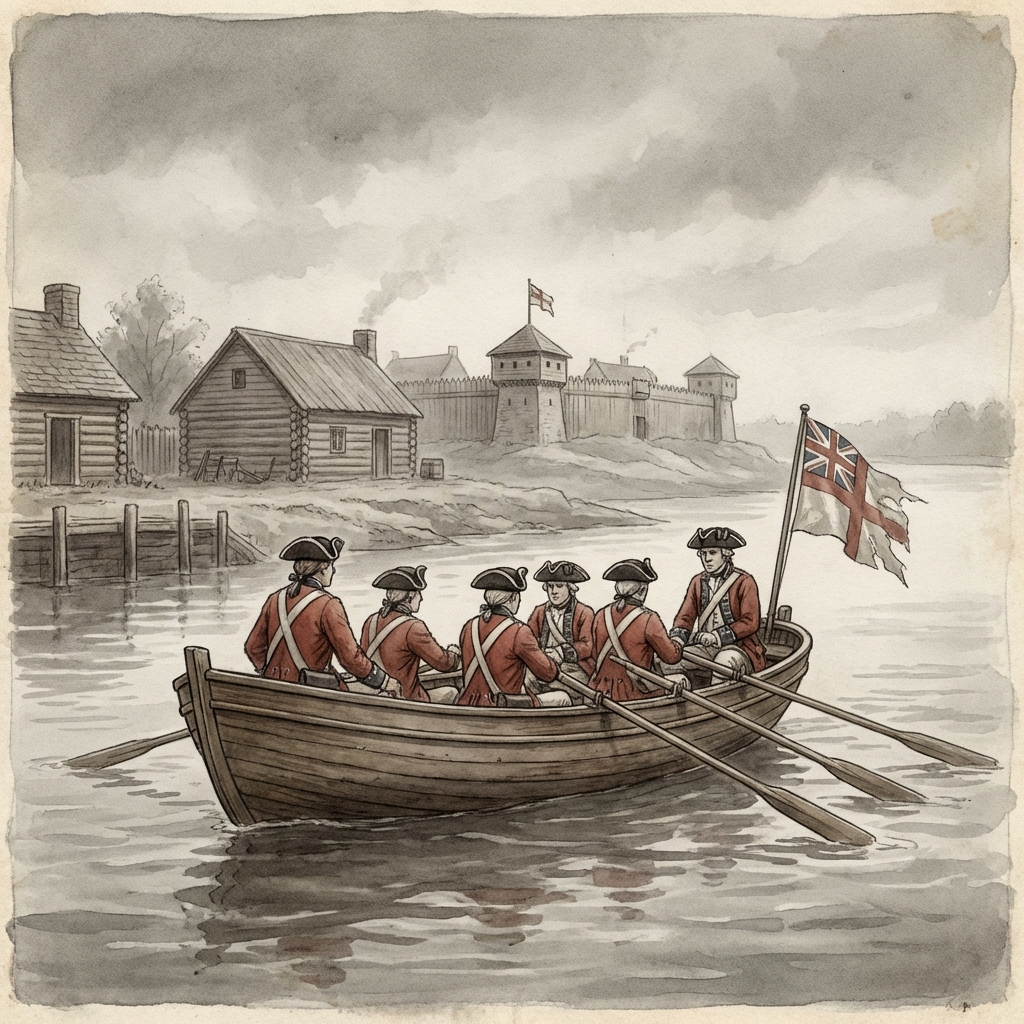
A small military boat, typically rowed or sailed, used for harbor patrol and customs enforcement. The Fort's yawl prowled Detroit's waterfront, inspecting arriving vessels and enforcing the new trade regulations.
The scene Samuel witnesses—the yawl "jogging" a crate to reveal contraband cloth—was a public lesson, meant to remind merchants that authority could find what it looked for.
The British military headquarters for the region, located at the center of the town. The garrison was small—typically a few companies of regulars—but represented Crown authority across hundreds of miles of frontier.
In 1774, the fort's commander answered to authorities in Quebec and ultimately London. The isolation bred both arrogance and anxiety among the British soldiers stationed there.
Official documents listing a vessel's cargo, required under British customs regulations. The Quebec Act of 1774 tightened enforcement, requiring detailed accounting of goods moving through frontier posts.
The corporal who "called for manifests and made the word sound like a punishment" embodied the new order—paperwork as a tool of control, documentation as a weapon.
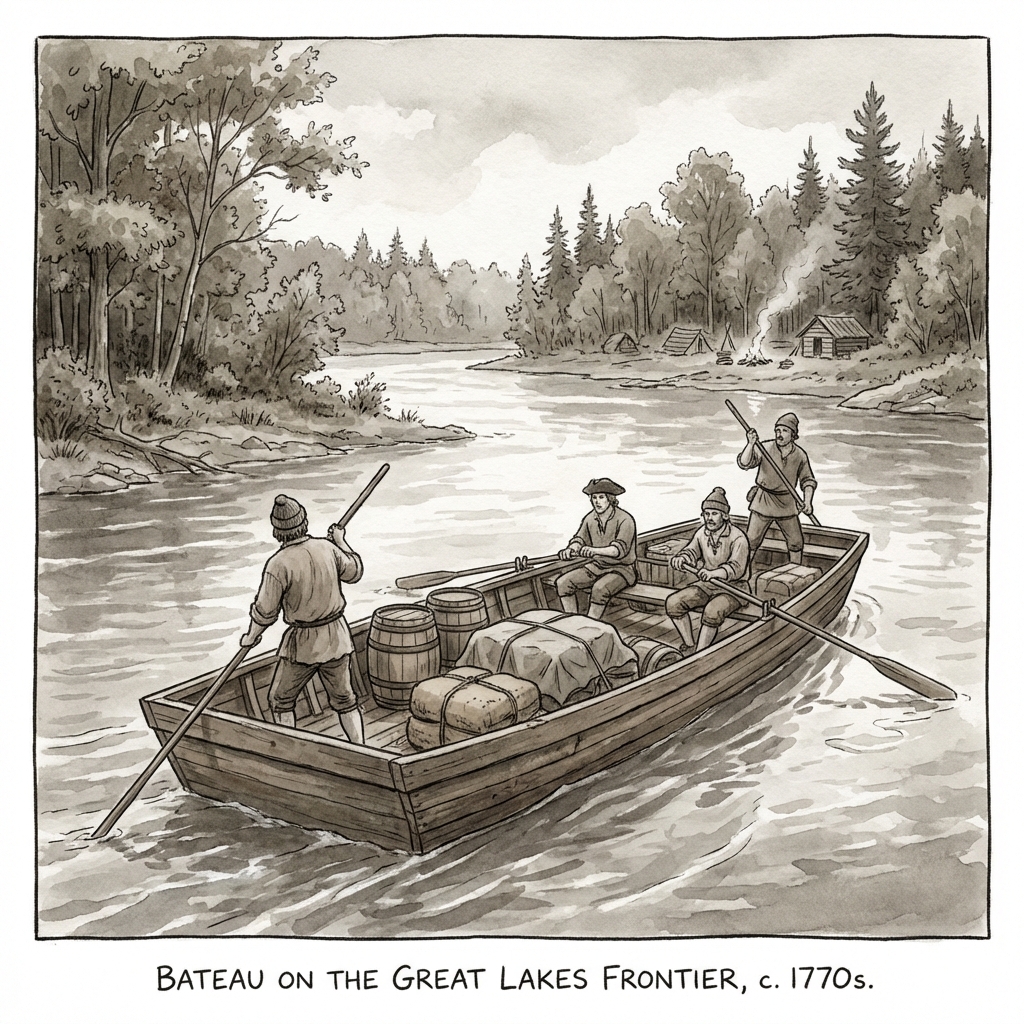
Flat-bottomed boats, larger than canoes, used for transporting cargo on the Great Lakes and connecting rivers. A typical bateau could carry several tons of freight with a crew of four to six men.
Samuel counts them automatically—three bateaux, one barge with a suspicious box. The habit of counting is becoming second nature.
One of the Six Nations of the Haudenosaunee (Iroquois Confederacy), whose traditional territory lay in present-day New York. Oneida people traveled widely for trade, and their presence in Detroit reflects the interconnected world of the frontier.
The Oneida woman selling combs "kept her mouth in a line that said she knew every word around her and would honor none that did not deserve it"—a survivor's wisdom in an occupied town.
A branch of British colonial administration responsible for managing relations with Indigenous nations. Agents wore distinctive green coats and carried diplomatic correspondence between posts.
Samuel tracks the messenger he names "Soft Knee"—three packets, shoes splitting at stress points, a pattern worth watching. The Department's business often intersected with the fur trade and frontier politics.
The trading firm of Samuel's father's partner, based in Detroit. After the violence at the Straits, Samuel has made contact—but carefully. He does not go near the building directly.
Whether Wilkens is ally, liability, or something between remains unclear. The back-alley entrance and the coded signals suggest a network operating in shadow.
A pair of drafting compasses—but also a Masonic symbol. Samuel's father wore a ring with the Square and Compasses; now the silver-haired man sets them on the table "as if to weigh the room."
Freemasonry provided networks of trust and mutual recognition across vast distances. On the frontier, Lodge membership could open doors that official credentials could not—and close them just as quickly.
Samuel's contact in Detroit—a man who sets compasses on the table, speaks of "order" in ways that echo Samuel's mother, and runs a network of observers and couriers beneath the Crown's notice.
His identity remains unclear, but his methods suggest a Lodge master or merchant leader coordinating resistance to the new customs regime. "We will teach you to fail quietly," he says. "It is a skill most men neglect."
Standard 18th-century ink made from oak galls, iron sulfate, and gum arabic. When diluted or applied lightly, the writing fades to near-invisibility—but heat or certain chemicals bring it back.
"Heat later, and the letters rise," the clerk instructs. Samuel's note appears to be "only a boy's scratch with numbers that add to nothing"—unless you know to hold it to a flame.
A name in the network—the man who will read Samuel's coded message. French-Canadian names dominate the resistance to British customs, reflecting the population's resentment of their new rulers.
"If the Fort interferes, he will swallow it and spit it later in the river where we know to look." The network has contingencies for compromise.
After the Quebec Act of 1774, customs officials tightened their grip on frontier trade. Duties were assessed, manifests demanded, and goods seized for real or invented violations.
"A woman argued with a customs man and lost." The daily friction of occupation—small humiliations that accumulated into the kindling of rebellion.