The Upper Country, 1774
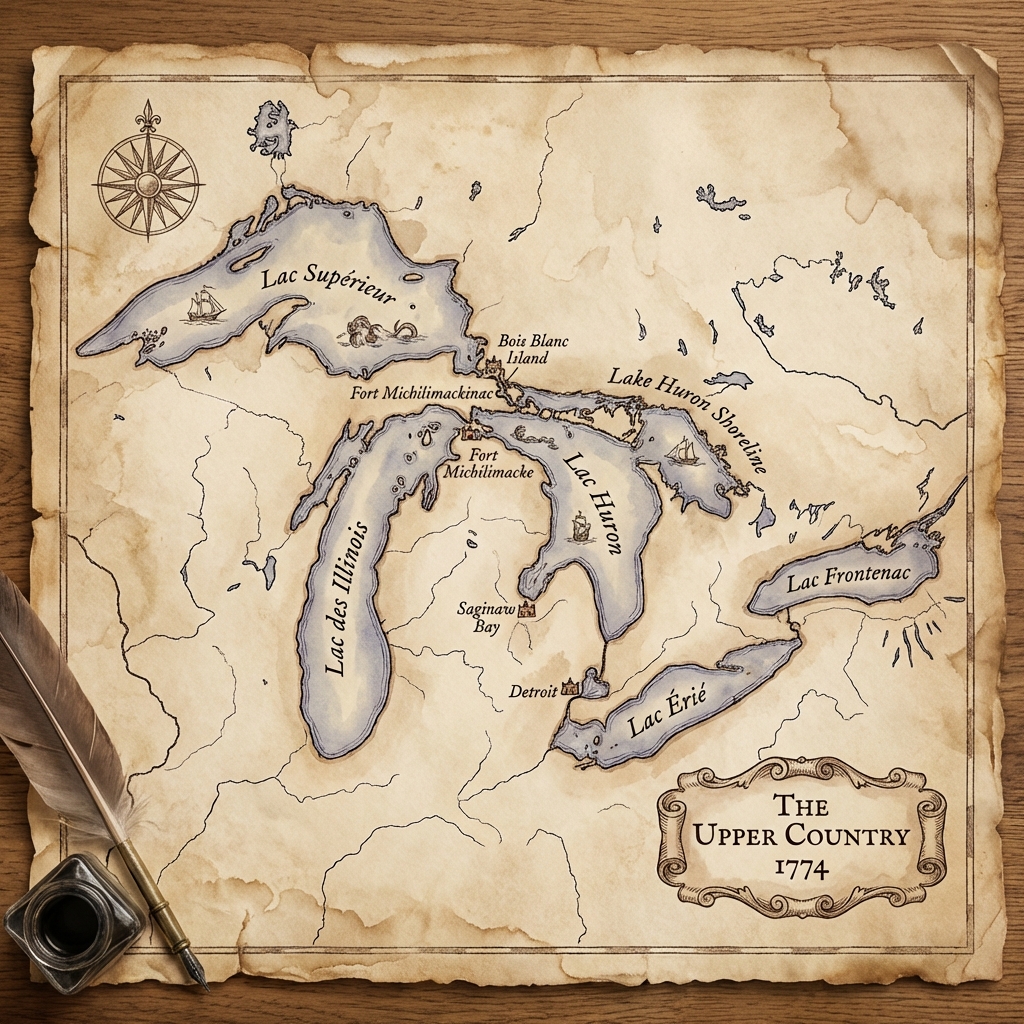
Samuel's journey from the Straits to Detroit.
Samuel's journey from the Straits to Detroit.
Late November 1774 — Huron Shore, north of Saginaw Bay
Morning came thin and colorless. Frost webbed the ground where he'd slept; each breath clouded and vanished. Samuel pushed himself upright, slow, his stomach clawing for what wasn't there. The trees creaked overhead like old ships in harbor.
He'd dreamed of bread—his mother's kind, heavy with cornmeal—and woke tasting bark. He chewed a bit anyway, bitterness going to grit on his tongue. Somewhere beyond the ridge, a crow called. It sounded like a man who'd run out of words and didn't care who heard.
The cold helped. It kept his thoughts straight. If he stayed in the pines, hunger would finish what the soldiers hadn't. If he moved, someone might see him. Either way, it was a man's choice on a boy's stomach.
He stood, brushed frost from his coat, and walked toward the light.
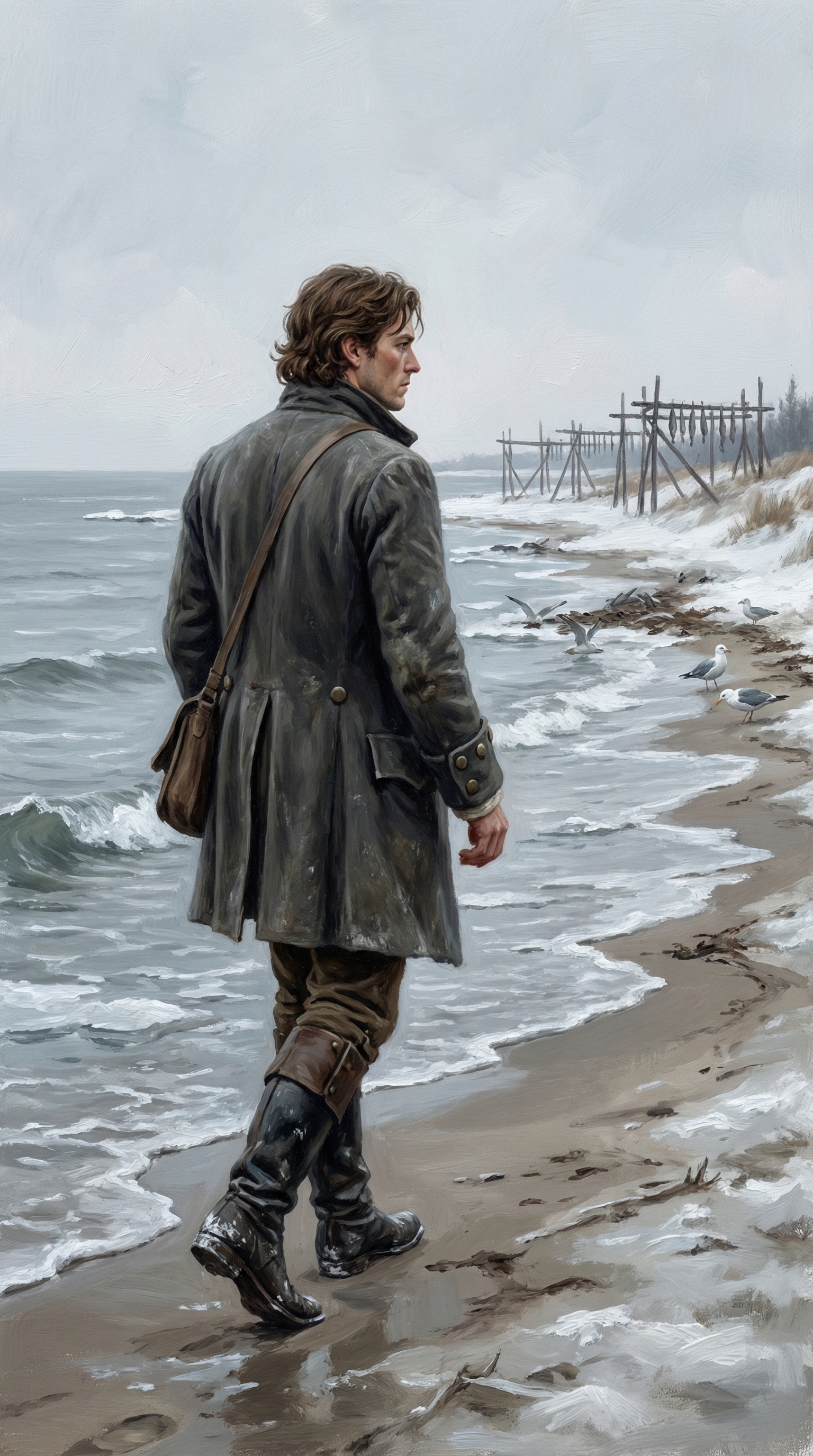
Samuel on the Huron shore, late November 1774
The lake ran in long iron breaths, shouldering onto the sand and sliding back with a hiss that sounded like sewing. Wind came clean from the northeast and hit him head-on. He kept to the hard strip where waves packed the shore flat, boots dark with soak, wood smoke on the air whenever the wind lost and let land win for a step.
Gulls worked the wrack line. Farther out, a pair of loons dove and came up near enough he could hear the rattle in their throats. Every so often a wave popped against a buried root and threw spray at his knees. The cold bit honest. It kept him awake where hunger wanted him soft.
Ahead, fish racks staked like fences threw square shadows on the sand. Nets hung from crosspieces—twine patched with twine until the mends made their own pattern. A ribbed canoe lay belly-up beside a coil of rope and three wooden pegs hammered in a crooked row. The smell was a stack: brine, pitch, wet bark, old guts. Men moved with the economy of people who'd done the same motions since thaw—one feeding line into a hand, one paying it out, one swearing soft in French when a knot took too long to mind itself.
Samuel stopped where they could see him well before they could wonder why they hadn't. He raised a hand halfway. Not a wave. Not a plea. Just proof he was a man with nothing in his right fist.
The older of the three—beard white at the mouth, a red kerchief gone dark with sweat—looked up from the net and took him in like inventory: cap pulled low; coat that had seen better dye; no musket; a knife, yes; hands raw; that tight jaw hunger makes. The man cut the net from its peg and let it fall across his forearm.
"You walk east or you run from west?" he asked, English shaped by another tongue.
"East," Samuel said. "And south when the shore lets me."
"South is wind and ice today." The man's eye went to the coil at Samuel's feet. "You know to coil?"
"Yes."
"Good. Coil." He nodded at the rope. "You coil and you don't talk unless told. Then no one owes you and no one owes me."
Samuel stepped in like a man hired yesterday—close enough to take orders, not close enough to borrow luck—and gathered the rope. He shook the wet from it as his father had with line at the strait and began the turns over-under so the twist would come out instead of in. Tar on the end stuck to his skin and made the cracks feel less like cracks.
The younger man, all shoulders and a bad hat, measured him as if weighing how much trouble he'd bring if trouble came hunting. The third, narrow and quiet, set a palm on the canoe's keel and rocked it once, listening for what only he could hear.
"Name me Baptiste Morin," the older said after a time, like he'd found the first question and answered it himself. "Those two are Pierre when it suits him and Jacques when it doesn't. Don't ask which is which."
Samuel didn't. He kept the rope neat and flat, each loop laid so it would feed. The work ate minutes, and minutes made a kind of food for a mind bent too long over the same hollow.
"Where do you sleep?" Baptiste asked.
"Where there's a roof," Samuel said. "When there's not, I make one."
Baptiste looked out across the chop. "You make a good roof at night and it becomes everyone's roof by morning." He flicked a knot with his thumbnail until it agreed to be a knot. "You carry a pack."
"Light," Samuel said.
"Light is the word men use when they've already thrown away what they needed." Baptiste tested the coil, nodded once. "Say ready."
"Ready."
"Not bad," he allowed. "Your hands are city, not river, but they learn fast."
"I'm of the strait," Samuel said before he thought better of it. The colder of the two younger men shot him a side look he couldn't read.
"The strait makes men," Baptiste said, not pressing. "And breaks them if they stand wrong. You have business south?"
"Yes."
"Then you're either wise or proud to walk where any man can count your steps."
"Wise would be inland," Samuel said.
"Wise would be a canoe," Baptiste said. "But canoes make questions at the wrong time." He hooked the net back and threw a tarp over the rack. "Come. We boil what won't keep. You eat if you cut wood, and you leave with the same hands you came with. That's the rule."
The word eat moved through him like a hot stone under a frozen foot.
They had a lean-to of cedar boughs and driftwood fetched together with the kind of logic that looks like accident until you try it yourself. The fire was half peat, half what the lake had given up. Steam lifted from a blackened pot. Pierre-or-Jacques prodded it with a stick as if a better stew might come up if he worried it long enough.
"Take that axe," Baptiste said, pointing with his chin. "Head's loose. Don't send it flying and take a man you need. Cut what fits the pot and what fits the fire."
Samuel set the axe head with a thump and twist—his father's trick for tools that still had more in them—then drove the wedge the last half-inch. The rhythm came back easier than he'd hoped. He split a length of cedar no thicker than his wrist and made kindling clean; then another; then more until the small pile said he had a right to sit.
Baptiste made space without ceremony. He ladled stew with the caution of a man who'd shared a hundred meals and learned where waste lived. Fish and potato and something sweet at the back of it. Samuel took the wooden bowl in both hands, didn't look at anyone, blew once to prove to himself he was still a man and not a dog.
He ate slow on purpose—one piece of fish, two spoonfuls of broth, a breath; one piece of potato; stop—because the first swallow woke a hurt. He kept his back straight. He kept his hands where all could see them. He didn't lick the bowl when it went clean.
"You know to leave a bite," Baptiste said.
"Sometimes the bite is the man," Samuel said.
Baptiste grunted agreement and put a little less in the bowl the second time. "Two rules," he said, handing it back. "Keep what you carry small enough to burn and big enough to trade. And walk with weather, not against men."
Samuel set the words where he set sums he couldn't afford to lose. "And the warning?"
Baptiste rubbed tar-dark ridges of thumb and forefinger. "Detroit customs count faster than a priest forgives," he said. "They'll name what they want order and you'll nod so they choose another head to wear the weight. Keep your hands open where they can see them. If a man speaks first, you speak last or not at all. If they don't ask your name, you don't spend it."
Wind pressed the lean-to's skin and made the cedar whisper like prayer. Pierre-or-Jacques flicked another stick into the fire and watched it catch like it had earned flame.
"Men in lace at the fort?" Samuel asked.
"Lace, yes," Baptiste said. "And men who wear none and still command." He wiped the back of his hand across his mouth. "New practice since the king gave Quebec his blessing and made the river a purse. They'd weigh the water if they could. They read French when French reads coin and forget it when French reads hunger."
Samuel felt the ledger under his shirt like a second set of ribs. He let his hands rest open on his knees the way Baptiste had said.
"You have a look," Pierre-or-Jacques said, first words from him. His voice had the flatness of men who spend their talk on weather and save none for faith. "Like you mean to keep a number in your head longer than your head wants it."
"I've numbers," Samuel said.
"Don't keep them all," the man said, chin toward the lake. "The waves do better with the ones that drown."
"Eat," Baptiste said, gentler than the word deserved. "Then you mend."
They finished the pot to the last broth line and cleaned bowls with the last heel of bread rubbed around inside and passed twice. Fullness sat shy of comfort. They went to the rack and Baptiste taught a tar-twine mend—little loop, turn, pull that brought the square back true without tightening into a lie that would kill the mesh. They worked until Samuel's fingers learned to make the knot with less thought, until wind peeled the last boil of stew from the lean-to's roof and left only smoke ghosts. Where his thumbs were cracked, tar made a black glove.
"You keep a bit," Baptiste said, touching a burned place. "Let the square be honest. Too much neatness means a man lied, or a man who will lie has put his hands in it."
"My father liked neat books," Samuel said, not sure who he was arguing with.
"Books are where you put the neat," Baptiste said. "The lake wants the truth."
They wrapped the net and pegged it under the rack. Baptiste showed how to pin a tarp so it would sing when a gust came wrong and stay quiet when the gust came right. "She'll tell you before the sky if you mind her. Listen at the corners."
They walked the shore with the last of the light. Driftwood lay like bones with the flesh boiled off; some pieces wore black from an old fire that had eaten what it could and left hardness behind. Baptiste stopped at a pile where waves had thrown timbers beyond easy reach and tapped a length with his boot.
"Black wood," he said, and the words felt like a place name. "Storm burned it in the reeds. Good for a small fire that won't show at distance. Good for a cook who needs heat and secrets both."
Samuel put his fingers to the char. It marked him smooth. He broke a thumb-length sliver without noise and slid it into his pocket. A man sometimes needs one honest thing to touch when thoughts go crooked. He didn't give the thing a reason in his head. Reasons can sour.
By the time the light failed, the wind had shifted enough to make the lean-to a friend and not a fight. They slept in a row with feet to the embers and boots under their heads. Baptiste woke once to listen, then slept again. Samuel woke to the sudden quiet that comes when wind dies and the lake remembers how to rest. He lay with the ledger between shirt and skin and held his breath till heart and book agreed on a pace.
Dawn came as a bruise at cloud's edge. Damp walked the shore like it had legs. Gulls had found something out past the point and stitched the air with that patient, ugly noise that means food. Pierre-or-Jacques pissed in the wash, shook his hand to throw cold from his fingers, and went to the pot with a face that said coffee would have mended the world if the world had any sense.
Baptiste handed Samuel a strip of dried fish and a hard biscuit. "Walk when the wind walks," he said. "Stop when the wind stops. Men who patrol look east in the morning and west in the evening same as everyone. If you must pass a house, pass in the hour the hearth smokes most—eyes sting and men don't stare so hard."
Samuel tucked the biscuit inside his coat where body heat might buy it a little softness. He waited for the last instruction. Baptiste scratched behind one ear like he was stirring up something he didn't like and let it out.
"Where the big river turns north for a mile and pretends it forgot south—" he drew the shape in sand with his boot, a bend like a crooked arm— "there's a birch with bark peeled off in one long tongue. Cross there. Bottom's sand and no deeper than your pocket. Soldiers ride the ferry two bends down because that's where the ferryman counts his coin."
Samuel fixed the drawing in his head. "Birch with a tongue. Sand bottom."
"You'll know her by her shame," Baptiste said. "Men peeled her ugly. She still stands. Worth remembering."
Samuel put the biscuit back in his coat. "Thank you," he said, in the tone men use when they know the price will show later and they'll pay it if they can.
Baptiste shook his head like thanks had bounced off him and gone into the lake. "Don't pick an argument with the shore," he said. "And don't let any man make you talk before he tells you what he means to do with your words."
He set a hand quick and firm on Samuel's shoulder, as a man fixes a barrel on a cart so it doesn't jump. Up close his beard smelled of smoke and salt. "If you come back this way, you're a man we've seen," he said. "That's all. If you don't, the lake took you. No shame in that either. Now go while the drizzle keeps faces turned to collars."
The drizzle had found its pace, fine enough to hang in the air and thicken it. The shore narrowed to a darker strip and the water ran like pewter. Samuel took to it without looking back often enough to mean anything by it. He moved with the same rhythm he'd seen Baptiste use to walk nets from peg to peg: step, set; step, set; no flourish.
Two dogs came down from a house above the dune—half-cur, half-wolf, wholly their own. He let his hands show empty and his eyes show boredom and kept a slow angle that gave them his smell without treating them like officials. They lost interest when his pace did not change. He held that pace past the house and the smell of frying fat and the hurt of knowing he couldn't have it.
When the shore swung in to meet a low river spilling yellow water, he cut up along its right bank under willow and alder. The world turned quieter. The lake's long breath left and the river's thinner talk took its place. He passed a stand of cedar that must have cooked in some old fire; the trunks wore black to the height a man could not reach. Crows stepped sideways on twig ends and watched him like men who had once been cheated and were willing to be cheated again if the story was new.
He found the birch with its peeled tongue three bends later. You would not miss it. The white bark hung like a banner turned to shame, the inside raw and dark where men had pressed their thumbs too hard and taken more than they needed. He stood and set the picture where pictures go when you need them later.
The ford ran pale against darker water, ripples smaller where sand beat the river for a span. He tested it with a stick like a man who didn't need the stick but respected the habit. Cold knifed through his boot leather when he stepped off and his breath left him without permission. He took the crossing slow, each foot finding bottom before the other left. At midstream the current laid a hand on his knee and asked him to sit. He leaned into it and kept his mouth closed so water wouldn't see an opening and make itself his friend. When he reached the far side, a lark sprang from the reeds like he'd stepped on a string.
He knelt, poured a boot out, and let the wet run back into the river where it belonged. He ate half the biscuit because he was trying to be the kind of man who could leave something for later even if later didn't exist. He saved the fish strip whole. It did a man good to know he could eat and choose not to.
He went on with the river left until it remembered where the lake lived and went to find it. When ground rose, he took a deer path bending around a dune and gave himself a look at the shore from enough height to name what was coming. Two bateaux shoved south, men bent like commas against the wind. Behind them a third boat rode lower than it should have, a patch on its bow a lighter square under wet—green under new pitch proud of itself.
The sight meant little here, but meaning is a habit. He counted men without letting his eyes look like they were counting. He marked spacing between boats. He watched who waved and who pretended to tie something until the wave had passed.
He walked until the light began to fail in a way he trusted. The drizzle made a friend of him by then, beading on his coat and running off the brim to make a curtain he could look through without being looked at. He found a cut in the dune where spruce had tried to take a stand and lost and made a place to sleep from their failure—boughs piled, tarp set, corners pinned just so the way Baptiste had shown, a line tied low so the roof would not drum and give him away.
He made a meal from what was left. Bread that had learned humility; a sip of water caught in a fold; a smell more than a taste of fish. He cleaned his knife on his boot and cut a notch in a small stick and put it in his pocket with the char sliver so his hand would find it first, not the ledger, when he reached without thinking. A man shouldn't touch the same truth too many times in a day.
Dark came proper. Somewhere inland, a dog barked at the wrong hour and was answered by another that had better reasons. The lake returned to its long breath. He lay with his head on his rolled coat and his boots set where a hand could find them in one reach. He let the day count itself back through him—rope, stew, black wood, birch with a tongue, ford—and felt each thing take its place on the map inside.
Sleep took him but not all the way. He kept a coin of wakefulness under his tongue.
He woke to a sound that wasn't water. Footsteps in sand have a rhythm even when careful; this was the quiet drag of a man who had learned to walk like he wanted to be forgotten. Samuel did not move. He let his breath go slower and set his hands open where a second pair of eyes might find them and decide open was better than closed.
The steps stopped at his tarp's edge and stayed through a slow count to fifty. He pictured a hat brim dripping, a coat salt-stiff, a man weighing a shape under oilcloth against a risk he hadn't come to take. The steps went on toward the lake and were eaten by the old hiss.
He lay until the sound turned into a story a man might tell himself to sleep again. Then he slept.
Morning had no color when it came. Sky and lake had agreed to be the same thing until a wind or a gull broke them. His coat was stiff with the part of rain that never finished the job. He packed neat and quick and left no sign but a place where sand had learned his shape and was already forgetting it.
He walked. The shore turned slow. South kept refusing him in small ways and then letting him have it. Midday brought a bank where willows knelt and dead reeds made a comb the wind played. Voices ahead—men, and the scrape of wood that meant a boat disliked where it was.
He eased behind a stand of young birch that wouldn't hide a grown man if a grown man truly needed hiding, and looked like a boy who'd stopped to piss and listen to the weather decide itself.
Two soldiers in red faced the water and swore in the kind of Latin that lives inside English. The boat they wanted had grounded itself on a bar like a cow that had thought better of the grass. A sergeant—hat with a better brim, mouth like a seam stitched too tight—kept his hands behind his back the way officers do when they mean not to help.
"Push, damn you," the sergeant said. "You'll make the fort before dark or your backs will remember why you didn't."
One private laughed without humor. The other pushed with an oar and watched his feet like he didn't trust them. Samuel took the measure of them as he did weather—two tired; one proud; one scared of one of those in ways that would matter later. He let that settle and eased on when their noise rose enough to cover the quiet his steps made.
Walk with weather, not against men.
By late day the lake had lowered its voice and let the shore mind its own business. He found another pocket, another small fire from wood a fire would not advertise. He ate what Baptiste's kindness had left and drank from a pool the lake had forgotten to claim. He set his tarp by a drift log burned black and thought on men who rename themselves to keep doing the work they were meant for. He put the thought away like the char sliver—near enough to touch when needed, far enough not to turn comfort into lie.
Before sleep, he palmed the iron-gall packet once for weight and put it back. Ink is a promise you make only if you must. He let numbers run through his head and then turned them loose one by one into the small flame until the fire had them and he didn't. The ledger at his ribs said it could remember for both of them if it had to.
Toward morning, drizzle came back, and with it a wind that favored his direction. He stood into it and felt how a man can lean on air when it comes correct. South waited like work waits—unimpressed, ready to take what you bring if you bring it steady.
He went to it.
☕ Enjoying this story?
 Buy Me a Coffee
Your support helps keep this serial going. Thank you for reading.
The long stretch of coastline running south from the Straits of Mackinac toward Detroit. In 1774, this was wilderness broken only by scattered French-Canadian fishing camps and Indigenous villages.
Samuel has been walking this shore for weeks, moving from the Straits toward Detroit—roughly 280 miles by water, longer by land.
A large bay cutting into Michigan's eastern shore. The area was home to Ojibwe and Odawa peoples, with French traders operating seasonal camps along the coast.
For Samuel, the bay represents progress—he's more than halfway to Detroit.
A French-Canadian fisherman working the Huron shore. Men like Baptiste lived between worlds—French by heritage, subjects of the British Crown since 1763, and neighbors to the Indigenous peoples who had fished these waters for generations.
His advice to Samuel reflects hard-won wisdom about surviving on a frontier where authority was distant but its reach was long.
British authorities at Detroit enforced trade regulations and collected duties on goods moving through the region. After the Quebec Act of 1774, enforcement tightened as the Crown sought to control the lucrative fur trade.
Baptiste's warning: customs officials "count faster than a priest forgives" and will "name what they want order."
Passed by Parliament in June 1774, the Quebec Act extended Quebec's boundaries to include the Ohio Valley and Great Lakes region, granted religious freedom to Catholics, and preserved French civil law.
While it placated French-Canadians, the Act infuriated American colonists—it was one of the "Intolerable Acts" that helped spark the Revolution. Baptiste's comment about the king making "the river a purse" reflects how the Act tightened British control over frontier trade.
Driftwood charred by old fires, prized for making small fires that produce less visible smoke. Baptiste teaches Samuel this frontier knowledge: "Good for a cook who needs heat and secrets both."
Samuel keeps a sliver of char in his pocket—"one honest thing to touch when thoughts go crooked."
A river crossing known to locals but not to soldiers, who use the official ferry downstream. Baptiste describes it by its landmark: a birch tree stripped of bark, standing "like a banner turned to shame."
"You'll know her by her shame. Men peeled her ugly. She still stands. Worth remembering."
Flat-bottomed boats used throughout the Great Lakes region for transporting goods and people. Larger than canoes, they could carry heavier loads but required more crew to handle.
Samuel watches three bateaux heading south—counting men, noting spacing, observing who waves and who pretends to be busy. Old habits from his father's trading post.
The distinctive red coats of British infantry. Samuel encounters a patrol struggling with a grounded boat—"two tired; one proud; one scared"—and slips past while their noise covers his movement.
Baptiste's rule serves him well: "Walk with weather, not against men."
The standard writing ink of the 18th century, made from oak galls, iron sulfate, and gum arabic. Samuel carries a packet of the dry ingredients—add water and you have ink.
"Ink is a promise you make only if you must." The ledger can hold the numbers; the ink is for when they need to be shared.