The Upper Country, 1774
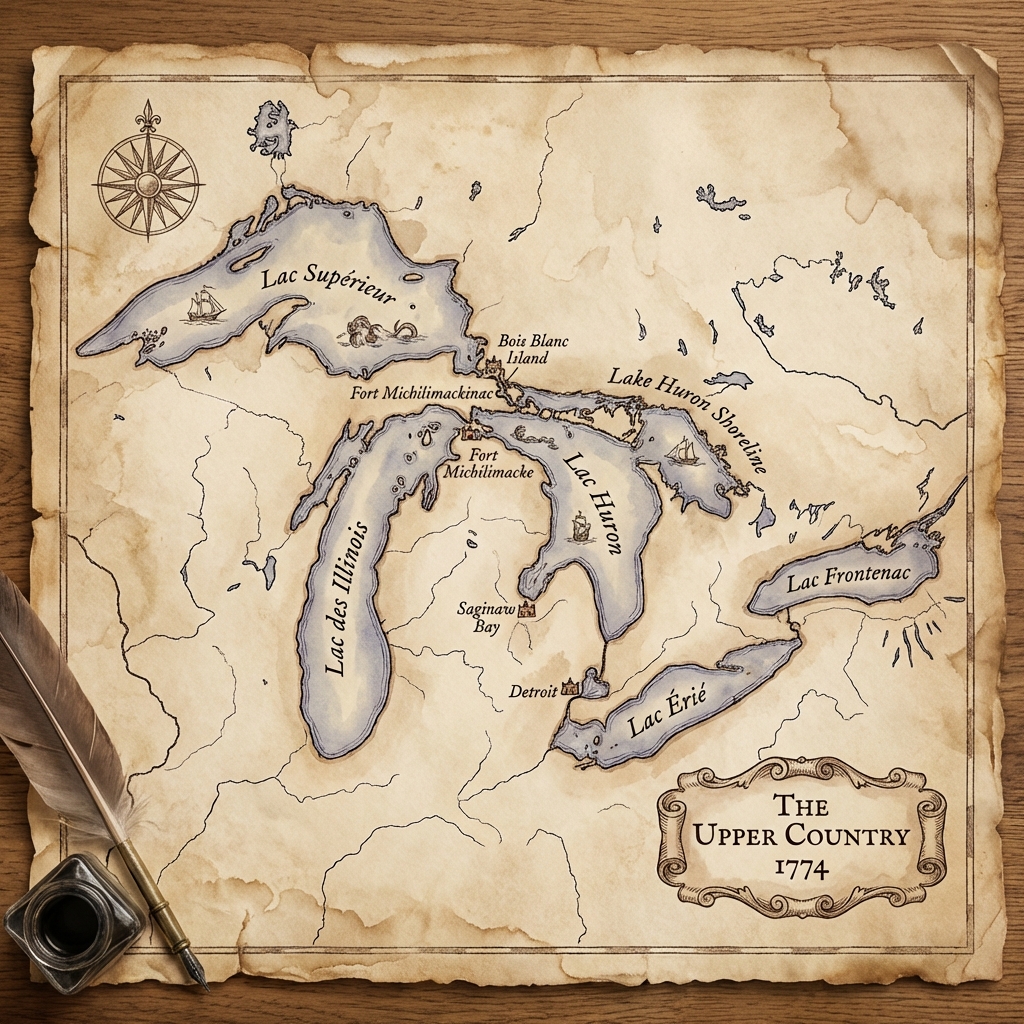
Samuel's journey from the Straits to Detroit.
Samuel's journey from the Straits to Detroit.
Early October 1774 — Straits of Mackinac, Michigan side
The day began with ice on the rope.
Samuel worked the stiff coil loose, his breath feathering the skiff's gunwale. Frost dusted the cedar thwarts; the lake lay like hammered pewter. To the east, first light slit the strait and flashed like a musket barrel before it fires. Gulls worried the chop between the point and the sandbar. Out on the gray, a paddle knocked wood—steady, unhurried.
Behind him the post woke: the stove door clanged, his mother set the kettle, his father coughed the night out of his chest. The room smelled of beaver, smoked whitefish, and tar. Ledger, quills, a brass weight set aligned like soldiers. Bales and barrels to shoulder height; fur bundles cinched with rawhide; a crate of gunflints and another of blue stroud. Their living, corded and counted, waiting for ice that hadn't come.
"Lines first," his father called. "Then you can eat."
"I already ate," Samuel said, though he hadn't. His stomach was tight, the way it got before weather turned.
He dragged the skiff higher and looped the thawing rope over the oak peg. The sand was welded hard from the night's freeze; each step cracked a thin crust. His mother came out with the kettle, plain wool gown under his father's old waistcoat, sleeves shoved to the elbow. Hair braided and pinned. She lifted the lid and tossed the first boil in a silver arc that steamed on the ground.
"Quick hands today," she said. "The voyageurs will be through before noon. I promised Dejean we'd have his bread."
"I'll fetch the flour," Samuel said.
"Let him finish the lines," his father called from inside. "Then flour. Order is money."
Samuel felt the wind slide off the big water. Northwest. Dry and sharp. It would hold.
Hoofbeats thudded on the packed sand up the beach.
His mother's eyes shifted past him and went flat in that way she had when she did a quick count and didn't like the sum. She set the kettle down, wiped her hands on her apron, and smoothed a stray hair as if tucking a word back.
Four redcoats rounded the scrub pine—two on foot, two behind with a packhorse. Travel-dull coats, white crossbelts dark with sweat. The forward man wore a sergeant's lace. He carried his hat in his fist like it deserved respect but not this early. Bayonets sat in their frogs; scabbards knocked thighs. The rear man had a paper case tied to his breast strap, King's seal pressed dark.
Samuel's father stepped into the doorway, wiping ink from his fingers. Clean linen shirt, waistcoat buttoned high. No coat—he liked officers to see the work in his arms. The ring on his right hand—Compasses and Square—caught a slit of light as he tapped the ledger's corner.
"Morning," he said, a merchant's welcome balanced on a thin edge.
"Sergeant Wray, 8th Regiment of Foot," the sergeant said. Weathered face, drumline posture. "We're here to inspect your cargo under His Majesty's late Act."
The man with the paper opened it and held it out.
His mother read first. Quick eyes. She handed it to her husband without looking away from Wray. "We are not a ship," she said. "Nor a warehouse of the Crown."
"All trade here falls under the Act now, madam," Wray said. "You may call it a post or a hut; the law names it a post."
Samuel's father glanced over the parchment though they all knew the words by now. Dry law: Quebec widened, customs gathered proper, violators seized and fined.
"This post," he said, tapping the ledger behind him, "chartered to Wilkens & Dunlap, licensed at Detroit under the Indian Department's stamp, '72. Our marks will match."
"You'll show your marks," Wray said. "Open each bale."
His father folded the paper neat and returned it. "We don't pay twice for the river," he said. "We paid at Detroit. The law—if law it is for men who've lived by another these twenty years—doesn't make us pay twice."
"It makes you pay what is due now," Wray said, setting his hat on slow, making it official. "And it makes you show what you carry."
His mother pressed her apron tie once, let it go, and stepped clear of the door. "Samuel," she said. "Bread for the men. And water for the horse."
Inside, the sergeant's men undid rawhide, levered lids, pressed palms into fur to feel for hidden weight. They cut the twine on a crate and found iron hoes, edges blued. They rolled a small keg to hear the slosh.
"For the priest," Samuel's father said. "Wine for Mass."
"For trade," the private replied, not looking up.
"Wine for Mass isn't taxed," his mother said. "Nor honest tools to clear a field."
"I don't write the names of the taxed things," Wray said evenly. "I write the names of the men who have paid them."
He took the ledger when it was offered, set it on the counter, and ran a blunt finger down columns straight as gun barrels. He paused over a line and looked up.
"Your last entry is three days past," he said. "Yet I count bundles here that aren't entered."
"They came in the night," Samuel's father said. The ring flashed as he gestured. "We keep honest accounts by daylight."
"You keep goods unmarked by the Act." Wray closed the ledger with two fingers and a small sound. "The fine is seizure. Today, I'll take the due and forgo the fine."
"For going," his mother said dryly, "is a mercy indeed."
Wray's eyes settled on her in a way that wasn't warm. "Your husband's tongue puts you both in want," he said. "I'd mind it."
She didn't look away. "Brother," she said to her husband, soft but edged, "mind your temper."
Samuel saw the flicker then—pride stoked and stepping forward. His father leaned his weight onto his palms on the counter; the knuckles went white. "The Department's mark is on those bales," he said. "We've paid what we owe. If your officer at the Fort wishes a quarrel with Wilkens & Dunlap, he can write Mr. Wilkens at Montreal. We'll answer in letters. Not here. Not with men and guns."
"Letters travel slow," Wray said. "Payment travels when it wants."
"Payment travels when it is due," his father said, and reached for the ledger.
A private slid in, thoughtless-near. His sleeve brushed Samuel's mother's hip and didn't apologize for it. The touch was light, meant to say something.
She put her hand over the ledger so the private's knuckles met her fingers. She didn't squeeze. She rested there until he moved. When he didn't, she gave him a look that had sent bigger men to the door to think again.
"Sergeant," she said.
"Harris," Wray said without looking. "Mind yourself."
Harris didn't move.
Samuel's father stepped around the counter, one hand raised to separate bodies. "That's enough," he said. "You'll tally what we owe, we'll pay what we owe, and you'll be on your way."
Harris smiled with one side of his mouth. "You'll pay more than you owe," he said under his breath, to the woman, where it could be kept or flung back.
His father's hand changed shape and then forced itself open again. "Take your hand off my wife."
The room drew in on the sentence. Even the stove seemed to swallow its tick.
Steel scraped leather. A bayonet left its frog.
It happened in the space between one breath and the next. His mother reached to push the muzzle aside. Harris yanked back. The blade tore his father's chest under the edge of the waistcoat—shallow, a ripping thrust that made him fold. Blood showed quick as spilled ink.
Wray's cane cracked the counter. "Hold!" he barked.
The other private, startled, knocked the keg. It thudded a barrel and rolled. He thumbed the cock out of habit, panic making his hands dumb.
"Don't—" Wray started.
Flint kissed steel. The pan flared. Thunder in a room too small for it.
Smoke punched them blind. The ball took his mother in the ribs from three paces. She staggered like a shoulder had bumped her in market and sat down slowly against the stacked blue stroud, eyes searching for something level enough to hold. She put her hand to the wound and looked at the red on her fingers like she'd spilled berry wine.
His father reached for her. Harris flinched and stumbled, yanking the bayonet free. The second tear opened. His father hissed between his teeth and sagged across the kegs.
Silence after the shot has its own pitch. Gulls outside went mad. The kettle screamed on the stove as if it had been waiting for its cue.
Wray slammed the private's barrel down, fury and fear tearing his face. "Are you deaf?" he hissed. "You'll hang us all."
Harris stared at the blood on his blade like it might explain itself.
Samuel found himself at his mother's side. He tried to press his palm over the wound the way she'd taught him for bad cuts. There was too much. It came around his fingers, warm in the cold room.
"Samuel," she said. Her voice was full and soft. "Take the ledger."
He shook his head and pressed harder. She turned his wrist with her good hand—a small practiced motion—and guided him to look. His father had slumped to the floor, mouth open as if to argue a price. His shirt darkened in a flower that kept opening.
"Ledger," she said again. "Order is—"
"Money," he choked.
Her mouth twitched, almost a smile. "And memory."
Wray crouched, the cane forgotten. His hands worked in the air, useless. "Madam—" he began, and stopped, the word too small and far too large.
Her gaze weighed him. "Get out," she said. "Take your men and get out of my house."
Wray stood like his bones had gone heavy. He turned on Harris. "You'll carry," he said. "And you'll keep your mouth shut from here to the Fort."
He backed to the door, hat in his hand again—automatic, useless. At the threshold he looked once at the ring on the dead man's hand and then away. "We'll take notice of this house," he said, voice stiff with fear. "As is the practice now."
They peeled themselves out of the smoke and into the white day.
Samuel tore the last ledger page free, folded it to his waistcoat lining, then took the whole book. Heavy as a child. He kissed his mother's temple.
"Go," she breathed. Warmth leaving.
He went because she told him to. Out the back, into frost shade and scrub willow, across the hard sand where his steps left bright breaks in the crust. He didn't look back. He could feel the house behind him like a pulled tooth—tongue seeking a shape that wasn't there.
Hoof iron rang thin from the beach. A gull cried and went on. He slid into the ditch and let the willows hide him.
Order is memory, he told himself, and ran bent for the creek.
The patrol left the hamlet under a pale sky, the officer insisting they had "restored order." Behind them, chickens scattered through ash and a child cried over something too small for soldiers to notice.
The officer rode first, his bay's hooves loud in the mud. The others followed, muskets slung, sacks of pilfered grain and cloth tied to their packs. The hamlet burned slow behind them, not a blaze—just a simmering spite.
No one talked. The youngest kept glancing back, jaw working like he was chewing words he didn't dare say. The faceless one trudged last, head down, listening to the wet hiss of fire in the distance.
"This will remind them who governs here," the officer said at last.
No one answered.
Then, faint over the wind, a dog barked from the trees. The sound followed them a long way, thin and relentless.
☕ Enjoying this story?
 Buy Me a Coffee
Your support helps keep this serial going. Thank you for reading.
The narrow waterway connecting Lake Michigan and Lake Huron—a strategic chokepoint controlling access to the western fur trade. In 1774, Fort Michilimackinac guarded the passage.
Despite European claims, the Ojibwe, Ottawa, and Potawatomi (the Three Fires Confederacy) maintained practical control of the surrounding territory.
A coarse woolen cloth manufactured in Stroud, England, specifically for the North American trade. Blue and red stroud were highly valued by Indigenous communities for clothing and blankets.
Trade cloth was among the most important goods exchanged for furs—alongside iron tools, weapons, gunpowder, and alcohol.
French-Canadian canoe men who transported furs and trade goods across the vast waterways of North America. They paddled birchbark canoes laden with hundreds of pounds of cargo, portaging around rapids and between watersheds.
Voyageurs were legendary for their endurance, their songs, and their role as cultural intermediaries between European traders and Indigenous nations.
Soldiers of the British Army, identifiable by their distinctive red wool coats. In 1774, small detachments garrisoned frontier posts like Michilimackinac, far from the main British forces in the east.
These men enforced customs regulations, maintained order, and represented Crown authority in territories where actual British control was tenuous at best.
The Square and Compasses—the emblem of Freemasonry. Masonic lodges were widespread among Scottish and colonial traders, merchants, and military officers in the 18th century.
Membership provided a network of mutual recognition and trust across vast distances—useful for men doing business far from courts and contracts.
The King's Regiment, a British Army infantry unit garrisoned at frontier posts including Michilimackinac. Soldiers like Sergeant Wray enforced customs regulations, maintained order, and represented Crown authority.
The regiment would later fight in the American Revolution, defending British interests in the Great Lakes region.
Passed by Parliament in June 1774, the Quebec Act formally incorporated the Great Lakes region into the Province of Quebec and imposed new customs regulations on the fur trade.
In the Thirteen Colonies, it was denounced as one of the "Intolerable Acts." Within months, the American Revolution would begin.
A trading partnership operating at the Straits. Such partnerships were common—combining capital from Montreal merchants with local knowledge and labor.
The Dunlap name suggests Scottish or Scots-Irish origins, common among frontier traders who sought opportunity where their outsider status mattered less than skill and endurance.
The largest settlement in the region, founded by the French in 1701. By 1774, Detroit served as the administrative center for the British Indian Department and the hub of the western fur trade.
The population was overwhelmingly French-Canadian—roughly 80% of European inhabitants. British soldiers and officials formed a small minority.
The British government agency responsible for managing relations with Indigenous nations. The Department licensed traders, distributed gifts to maintain alliances, and tried (often unsuccessfully) to regulate the frontier.
Its agents wielded enormous influence—and were often accused of corruption, playing favorites, and enriching themselves through the trade they were supposed to regulate.