The Upper Country, 1774
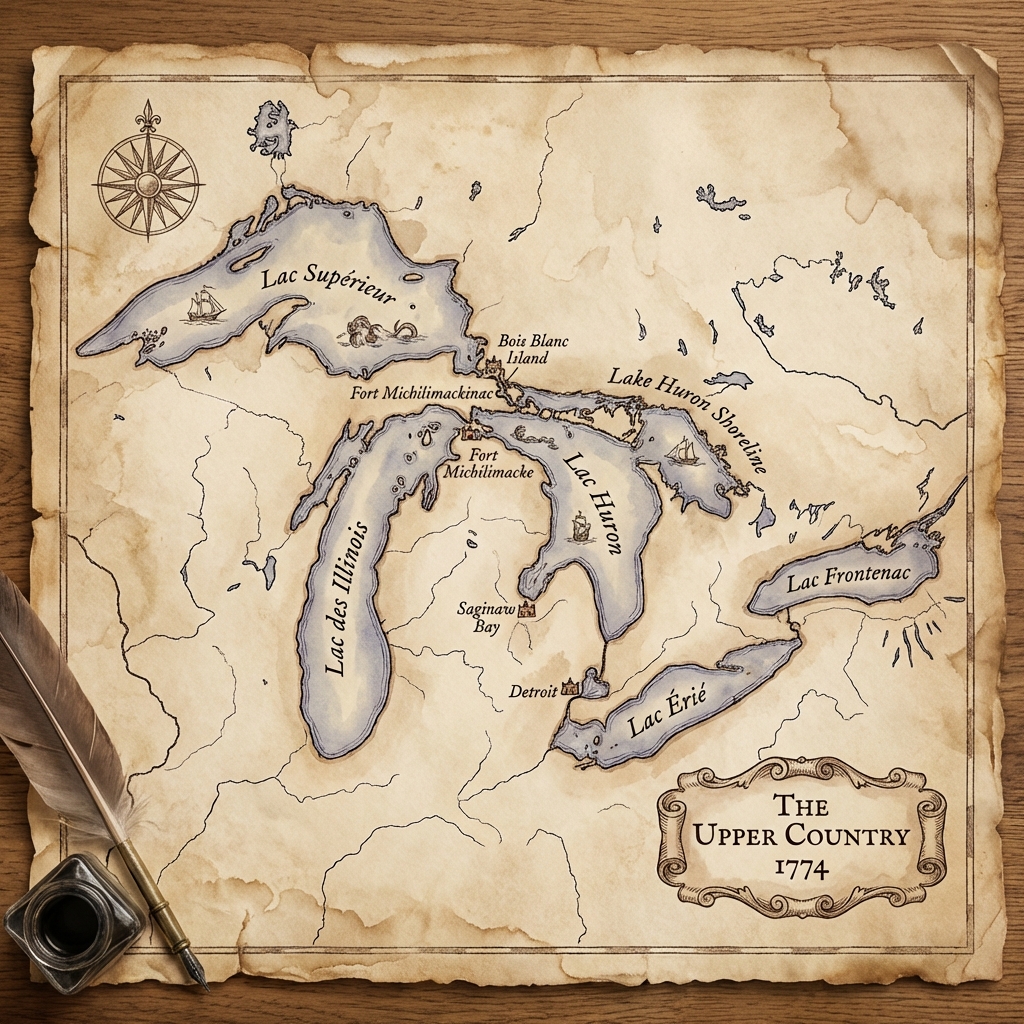
Samuel's journey from the Straits to Detroit.
Samuel's journey from the Straits to Detroit.
Late December 1774 — South of Detroit
“We’re going visiting,” Baptiste announced.
They walked inland, following a trail that existed more in Baptiste’s memory than on the ground. Three hours through forest that had never seen an ax, around frozen marshes that would swallow a man in summer, over ridges where you could see Lake Erie stretching like hammered steel.
The waystation sat in a hollow between hills—a cabin that wanted to be invisible and mostly succeeded. Smoke rose straight in the still air. Dogs announced them from a hundred yards out.
“Dumont’s place,” Baptiste said. “He’ll hate you.”
“Why?”
“Because you’re young, English-speaking, and wearing boots that still remember the store. But he’ll feed you. Dumont feeds everyone. It’s his curse.”
Dumont was everything Baptiste promised—suspicious, hostile, and generous in spite of himself. He was also enormous, with hands that could crush walnuts or build music boxes, depending on mood.
“Baptiste,” he growled in French, then switched to accented English for Samuel’s benefit. “You bring British spy to my house?”
“I bring a boy who needs educating.”
“Educate him somewhere else.”
“Marie!” Baptiste called past Dumont. “Your husband’s being inhospitable again!”
A woman appeared—small, fierce, with eyes that had seen too much to be impressed by anything. She looked at Samuel like he was a horse she might buy if the price was right.
“He’s scrawny,” she said.
“He’s learning,” Baptiste replied.
“Learning what?”
“How to be useful.”
She considered this, then stepped aside. “Come in. Dumont’s making stew. He always cooks when he’s angry. We eat well when the British annoy him, which means we’re fat all winter.”
Inside, the cabin was larger than it looked—one room but cleverly divided, with a loft above and a root cellar below. The walls were covered with pelts, tools, and maps that looked hand-drawn.
Dumont ladled stew into bowls without looking at them, his movements automatic. They ate in silence that had weight to it. Finally, Marie spoke.
“The soldiers came here too. Yesterday.”
Baptiste looked up sharp. “And?”
“Dumont wasn’t home.” Her smile was thin as ice. “I told them he was trapping north. They believed me because women are stupid and can’t lie.”
“What did they want?”
“Same as always. To count what we have so they can take half.” She looked at Samuel. “Your people love counting.”
“They’re not my people.”
“No? You speak English. You wear English boots. You probably pray to English God.”
“I pray to the God my mother taught me,” Samuel said, heat in his voice. “She’s dead now. British killed her for keeping honest books.”
Silence. Dumont stopped eating, looked at Samuel for the first time.
“Your name?”
“Samuel Dunlap.”
“The Straits?”
Samuel nodded.
Dumont and Marie exchanged glances. Something passed between them—decision, recognition, something.
“I knew your father,” Dumont said finally. “Not well. But I knew him. Straight dealer. The ring he wore—compasses and square?”
“Yes.”
“Thought so.” Dumont went back to eating. “Baptiste, why is this boy really here?”
“To learn the shore. To understand what moves below British sight.”
“And to carry messages,” Samuel added, surprising himself with the honesty. “To connect Detroit with the lakes.”
Marie laughed—short, bitter. “Messages. Boys carrying paper between men who think paper matters.”
“Paper can matter,” Samuel said, thinking of the ledger.
“Paper burns. Paper tears. Paper gets seized.” She stood, began clearing bowls with controlled violence. “You want to know what matters? Come.”
She led them to the root cellar. In the corner, hidden behind potato barrels, was a cache that took Samuel’s breath. Muskets. Powder. Shot. Knives. And underneath, wrapped in oilcloth—
“Books?” Samuel was confused.
“Medical texts,” Marie said. “In French. How to set bones. Birth babies. Treat fever. The British burn French books when they find them. Say we should learn English if we want to read.”
“So you hide them with weapons?”
“Books are weapons. A woman who can birth babies without British help is dangerous. A man who can set his own broken bones doesn’t need their charity.” She covered the cache carefully. “Your paper messages? They matter for a season. This knowledge? This lasts.”
Back upstairs, Dumont had pulled out a jug that smelled like paint thinner and bad decisions.
“Applejack,” he said, pouring four cups. “Made it myself. It’s terrible.”
It was terrible. Samuel coughed, eyes watering. The others laughed.
“Now,” Dumont said, “let me tell you about the shore. Not Baptiste’s fishing shore. The real shore.”
He pulled out one of the hand-drawn maps, spread it on the table. It showed the Detroit River down to Lake Erie, but with details no British map would include. Hidden coves. Seasonal streams. Indian trails. Safe houses marked with symbols Samuel didn’t recognize.
“Seventeen places between Detroit and the lake where you can hide goods,” Dumont said, his finger tracing routes like a builder reading blueprints—each line a beam, each junction a joint that had to bear weight. “Eleven families who’ll shelter you if you know what to say. Four crossing points where ice holds even in warm winters. This is sixty years of French knowledge, laid down like foundation stones. British been here fifteen years and think they own the whole structure.”
“Why show me this?”
“Because Baptiste vouches for you. Because your father was one of them.” Dumont pointed to the compass and square sketched in the map’s corner. “Because things are moving toward something, and when it comes, we’ll need young men who know the old paths.”
They talked until midnight—about trade routes, British patterns, which officers took bribes, which ones were dangerous because they didn’t. Marie told stories of her grandmother, who’d lived here when it was all French, when Detroit was spelled with a D and an apostrophe, when the only law was winter and the only government was survival.
“The British will fall,” she said with certainty. “Maybe not this year. Maybe not next. But empires always fall here. The winter eats them.”
“And then what?” Samuel asked.
“Then whoever comes next thinks they own it, and we start over. Hide books. Hide weapons. Hide ourselves until they fall too.”
“That’s not much hope.”
“Hope?” Dumont laughed. “Boy, hope is mortar—it holds the stones together but it won’t keep the rain out by itself. We don’t need hope. We have patience. The shore was here before countries. Will be here after. We just keep our heads down and outlast whoever’s currently nailing their flag to the ridgepole.”
When they left the next morning, Marie handed Samuel a package wrapped in cloth.
“Bread,” she said. “And something else. Don’t open it until you’re back in Detroit.”
The walk back to Baptiste’s camp was quiet. Samuel could feel knowledge settling in him like silt in still water—layers of understanding about how people survived when law turned lawless.
“Dumont and Marie,” he said finally. “They’re part of your network.”
“Everyone’s part of everyone’s network out here,” Baptiste replied. “That’s how we survive. British think we’re separate—French, Indians, traders, farmers. But winter makes everyone the same. Cold doesn’t care what language you speak.”
They came at dawn—two voyageurs and an Ojibwe woman, arriving at Baptiste’s camp like they’d been expected.
“Baptiste!” The taller voyageur, missing two fingers on his left hand, embraced the old man like a brother. “Heard you had trouble.”
“Trouble found me. Different thing.”
They’d brought supplies—flour, salt, a new net to replace the one the soldiers had destroyed. Without being asked, they began helping rebuild what was left of the damage.
Samuel watched them work, noted how they moved together without speaking, each knowing what needed doing. The woman—Baptiste called her Singing Crow though Samuel doubted that was her real name—set up a loom made from branches and began weaving replacement cloth for the torn shelter. Her hands moved with the certainty of someone who had repaired what others had broken many times before.
“Your boy?” Two-Fingers asked, nodding at Samuel.
“Learning boy. From Detroit.”
“Ah. One of theirs.”
“One of ours,” Baptiste corrected. “His parents died at the Straits.”
That changed things. Two-Fingers looked at Samuel differently—not suspicious now but measuring.
“You’re young for this work.”
“Work doesn’t care about age,” Samuel replied.
Two-Fingers laughed. “True. I was twelve when I first went up the lakes. Thirty years ago. British were coming then too. Still coming now. Like seasons—always arriving, never quite here.”
They worked through the morning. At noon, Singing Crow made something from corn and fish that tasted like wisdom. They ate together, sharing food and information in equal measure.
“Fort’s sending more patrols,” Two-Fingers reported. “Looking for weapons they say are coming from the south.”
“Are they?”
“Does it matter? They’ll find weapons whether they exist or not. British see what they need to see.”
Singing Crow spoke for the first time, her English careful but clear. “My people say the ice will break early this year. March, maybe February. When it does, things will move that have been frozen.”
“War?” Baptiste asked.
“Change,” she said. “War is just one word for change.”
They left at dusk, taking nothing but leaving everything different. After they were gone, Baptiste sat by the fire, feeding it driftwood piece by piece.
“You see how it works?” he asked Samuel. “They came because they heard. They helped because that’s what you do. Next month, maybe Two-Fingers needs help. Someone will come. Maybe me. Maybe someone I send.”
“Like a network.”
“No. Network is a British word. Makes it sound organized. This is just… people. People who remember favors and pay them forward. People who know winter comes for everyone, so you help when you can.”
“The British would call it conspiracy.”
“British call breakfast conspiracy if it happens without their permission.” Baptiste pulled out his pipe, packed it with the tobacco he’d hidden from the soldiers. “Let me tell you something about conspiracy. Real conspiracy isn’t men in shadows making plans. It’s this—people helping people because the alternative is letting power win.”
The morning Samuel was to leave, Baptiste woke him before dawn.
“One more thing to show you.”
They walked to a part of the shore Samuel hadn’t seen—a small inlet hidden by overhanging trees. There, cached under branches and canvas, was a bateau. Small, but solid. The kind that could make it to the islands if handled right.
“For when you need to leave quick,” Baptiste said. “Remember this place.”
“You think I’ll need to run?”
“Boy, everyone needs to run eventually. Question is whether you’ve planned for it.” He pulled the canvas back over the boat. “This inlet stays open even in hard freeze. Current’s funny here. Remember that.”
They walked back to camp where Samuel’s few things waited. As he prepared to leave, Baptiste handed him something wrapped in leather.
“Don’t open it now. Wait until you need it.”
“How will I know when I need it?”
“You’ll know.”
The walk back to Detroit took most of the day. Samuel’s boots had learned the road now—where the mud was worst, where ice made shortcuts possible, where to avoid sight lines from the fort.
As the city’s smoke came into view, he felt the weight of return. Nine days with Baptiste had changed something. Not just knowledge—though he’d gained that. Something deeper. An understanding that the shore was its own country, with its own citizens, its own laws that had nothing to do with paper or kings.
At the city gate, guards he didn’t recognize waved him through without interest. A boy with muddy boots and fish smell wasn’t worth their time.
He went first to the church, where Father Delisle took one look at him and said, “You’ve been educated.”
“How can you tell?”
“Your eyes. They’re older.” The priest handed him bread and wine. “Eat. Rest. Tomorrow you report what you’ve learned.”
In his small room, Samuel finally opened Marie’s package. Bread, as promised. But underneath—a small knife, French-made, with a handle carved from black wood.
There was a note: For when paper isn’t enough.
He turned the knife in the candlelight. Black wood. Like the charred splinter in his pocket. Like the name he was growing into.
Then he opened the leather bundle from Baptiste. Inside was a piece of paper, water-stained and old. On it, in his father’s handwriting, was a single line:
The shore remembers everything. Trust Baptiste. —J.D.
His father had known Baptiste. Had trusted him enough to leave this message. How? When?
Samuel sat on his narrow bed, knife in one hand, note in the other, feeling the threads of connection he was only beginning to see. Networks within networks. His father had been part of this, long before the customs inspection that killed him.
Tomorrow he would report to the silver-haired man. He would share what could be shared, keep what needed keeping. He would continue learning the difference between the two.
But tonight, he grieved—for his parents, for Baptiste’s broken ribs, for Marie’s hidden books, for all the people ground between empire’s wheels and the shore’s patience.
Outside, December wind brought the sound of soldiers marching, drums beating time.
Inside, Samuel opened the ledger. For a long moment he stared at the columns of transactions—his father’s careful hand, his mother’s marginal notes, the arithmetic of a life measured in pelts and provisions. Then he turned to a blank page. What he wrote next would not be a transaction. It would be something the ledger had never held before.
Using the heat-activated ink the clerk had taught him, he began recording not transactions but transformations. His own, yes. But also the shore’s—that other country that existed alongside the British order, patient as ice, inevitable as spring.
Order is memory, he wrote.
Then, in invisible ink: Memory is the shore that remains when empires recede.
☕ Enjoying this story?
 Buy Me a Coffee
Your support helps keep this serial going. Thank you for reading.
Hidden cabins positioned along trade routes and escape paths served as rest points, supply caches, and intelligence nodes. Waystations were deliberately difficult to find—invisible to anyone who didn’t already know where to look.
Dumont’s cabin represents a common frontier pattern: a structure that served simultaneously as home, trading post, arsenal, and library. The root cellar hiding both muskets and medical texts reflects the reality of life under occupation—survival required weapons for the body and weapons for the mind.
A French-Canadian frontiersman who operates a waystation between Detroit and Lake Erie. Dumont is a builder by nature—his hands “could crush walnuts or build music boxes, depending on mood”—and he thinks in terms of structures, foundations, and joints that bear weight.
His hand-drawn maps contain sixty years of French knowledge about the shore: hidden coves, seasonal streams, Indian trails, and safe houses. This geographic intelligence, passed through generations, represented a form of power the British could never fully suppress.
Frontier families maintained hidden stores of weapons, supplies, and knowledge against the possibility of confiscation or raid. Root cellars, false-bottomed barrels, and buried caches were common throughout the Great Lakes region.
Marie’s cache is notable for what it combines: muskets alongside medical texts. The British policy of suppressing French-language books—part of a broader Anglicization effort—made knowledge itself contraband. A woman who could deliver babies without British assistance represented genuine independence from Crown authority.
An Ojibwe woman who arrives with the voyageurs to help rebuild Baptiste’s camp after the British raid. Her name—likely not the one she was born with—reflects the frontier practice of using trail names that revealed nothing to outsiders.
Her quiet prophecy that “the ice will break early” carries double meaning: a weather prediction and a political forecast. Indigenous knowledge systems often encoded strategic intelligence within natural observation—a language the British could overhear without understanding.
A flat-bottomed boat cached in a hidden inlet, kept ready for emergency departure. The Great Lakes frontier offered an advantage that landlocked regions did not: the water provided escape routes that were difficult to patrol and impossible to wall off.
Baptiste’s note that “this inlet stays open even in hard freeze” reflects practical knowledge about local currents—the kind of intelligence that could save a life and that no British map recorded.