The Upper Country, 1774
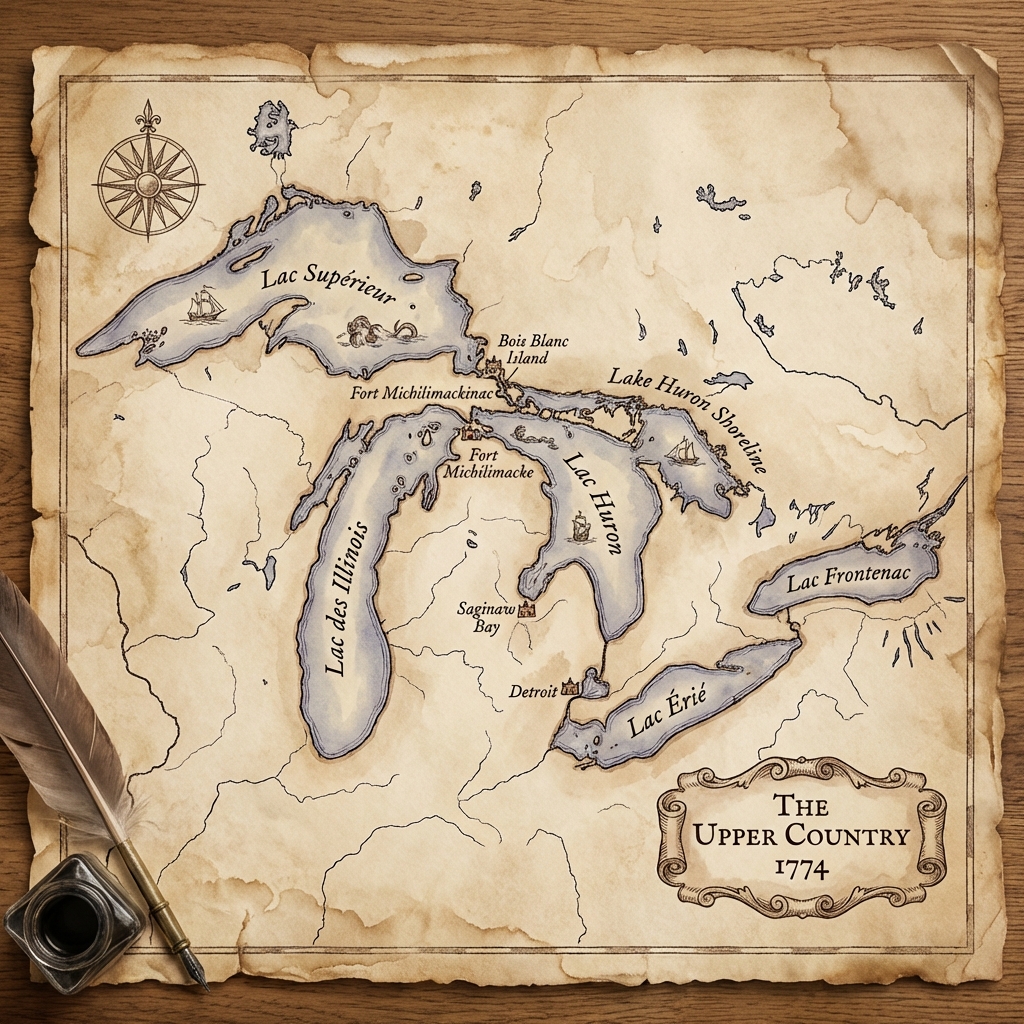
Samuel's journey from the Straits to Detroit.
Samuel's journey from the Straits to Detroit.
Mid-December 1774 — Baptiste’s Camp
On the fourth night, Baptiste got drunk. Not sloppy—Samuel doubted the man did anything sloppy—but loose enough to tell stories.
“First came here in ’58,” he said, feeding the fire driftwood that popped green and blue from salt. “French still thought they owned it. Then British came. Then Pontiac reminded everyone that neither of them owned shit. Now British are back, making laws about customs and duties and who can trade with whom, like paper changes rivers.”
“You fought with Pontiac?”
“Fought near him. Nobody fought with Pontiac except Pontiac.” Baptiste took another drink. “Watched British try to take Detroit. Watched them fail. Watched them come back with smallpox blankets because when you can’t win clean, you win dirty.”
“Smallpox blankets?”
“Gifts. From the fort to the tribes. Blankets from their hospital. Half the Wyandot dead in a season.” Baptiste’s voice went flat. “That’s your British order. Death wrapped in wool, handed out like charity.”
Samuel thought of Sergeant Wray, of his parents bleeding out on clean boards. Different deaths, same order.
“Why didn’t you leave?”
“Where would I go? This is my shore. My father fished here. His father trapped here. British, French, American—they’re weather. They pass. The shore stays.”
That night, Samuel dreamed of rivers running backward, of fish speaking French, of blankets that killed with kindness.
On the fifth day, soldiers came.
Six of them, led by a sergeant Samuel didn’t recognize—younger than Wray, hungrier, with the kind of authority that needed to prove itself daily.
Samuel was checking nets when he heard horses. Baptiste, cleaning fish, didn’t even look up.
“Get small,” he said quietly. “Watch. Don’t act.”
The soldiers dismounted like they owned the ground beneath them. The sergeant kicked over Baptiste’s drying rack, sending a week’s worth of smoked fish into the sand.
“Inspection,” he announced.
“Of what?” Baptiste’s voice stayed mild, but Samuel saw his hand drift to where his knife waited.
“Contraband. We’ve had reports of untaxed fur trading from this camp.”
“I’m a fisherman.”
“And I’m the King of France.” The sergeant nodded to his men. “Search it all.”
They tore the camp apart with efficiency that said they’d done this before, enjoyed it, gotten good at it. Baptiste’s shelter became kindling. His cached supplies—salt, flour, dried beans—got poured into mud. One soldier pissed on the ruins, laughing.
Samuel pressed himself smaller behind the overturned boat, fury building in his chest like steam in a kettle. His hand found a rock, sized for throwing.
Then he heard the silver-haired man’s voice in memory: Watch. Remember. Do not act from anger.
He let the rock go. Watched. Remembered.
The youngest soldier found Baptiste’s tobacco wrapped in oilcloth. “Sergeant!”
The sergeant weighed the bundle in his hand. “No tax stamp.”
“Bought it in Detroit,” Baptiste said. “Have the receipt.”
“Don’t see a receipt.”
“Because you’re not looking.”
The blow came fast—musket butt to ribs. Baptiste went down hard, gasping. The soldiers laughed. The young one looked sick but laughed anyway, learning how.
“Next time we find you trading off-books,” the sergeant said, standing over Baptiste, “we take more than tobacco. Maybe we take you. Fort’s prison is cold this winter. Men die there. Natural causes, of course.”
They left Baptiste bleeding in the sand, rode away singing a marching song about glory.
Samuel crawled out, helped Baptiste sit up. The old man spat blood, breathed carefully, spat again.
“Ribs?”
“Bruised, not broken. Had worse from my first wife.” Baptiste tried to laugh, coughed instead. “The tobacco—help me up.”
Samuel supported him to where the shelter had stood. Baptiste dug in the ruins, pulled out an undamaged oilcloth bundle. Inside, tobacco and a receipt dated two days ago, stamped with the Crown’s seal.
“But… you had the receipt. Why didn’t you show them?”
Baptiste looked at him like he was simple. “Boy, you show them the receipt, you admit they have the right to ask. Today they want to see receipts. Tomorrow they want to count your breaths, tax those too.”
“So you let them beat you?”
“Beat me? They knocked me down. I’ve been knocked down by weather, by women, by bears once. Getting up is what matters.” Baptiste pressed his ribs, winced. “Besides, tobacco’s easier to replace than pride.”
They spent the rest of the day rebuilding. Samuel learned that Baptiste had three shelters cached in the woods, each with supplies. The one the soldiers destroyed was the one he wanted them to find.
“Always give them something to break,” Baptiste said. “Makes them feel accomplished. Accomplished men don’t look harder.”
As they worked, others appeared. The Wyandot women brought medicine for Baptiste’s ribs. The habitant with the turnip cart brought lumber. The voyageurs heading north brought rum and rage.
“We could take them,” one voyageur said. “Six soldiers? The shore has twenty men who’d fight.”
“And then?” Baptiste asked. “British send sixty. We kill those, they send six hundred. That’s how empires work—they can afford to lose more men than you can afford to kill.”
“So we do nothing?”
“We do what we’ve always done. We survive. We remember. We wait.” Baptiste looked at Samuel. “And we teach the young ones what waiting means.”
That night, around a fire rebuilt from scattered coals, Baptiste taught Samuel the real shore network. Not the routes and safe houses—those were just logistics. The real network was this: people who’d been knocked down so many times that getting up had become a form of revolution.
“The silver hair in Detroit,” Baptiste said, “he thinks revolution means documents and declarations. Maybe it does, for men who own things. But out here? Revolution means the British break your shelter and you build another. They steal your fish and you catch more. They beat you down and you get up. Every time you get up, you tell them their order isn’t the only order.”
Samuel thought of the ledger against his ribs. His father had believed in written order, accounts kept clean. Baptiste believed in something else—order that couldn’t be written because writing made it vulnerable to seizure.
“What do you believe?” Baptiste asked, like he could read the thought.
Samuel considered. “I believe my parents died for keeping honest books. I believe you got beaten for having a receipt. I believe the British make laws to break them when convenient.”
“That’s what you don’t believe. What do you believe?”
The fire popped, sending sparks into darkness. Somewhere out on the river, a loon called—wild, mocking, free.
“I believe in getting up,” Samuel said finally. “And in remembering why you got knocked down.”
Baptiste smiled, passed him the rum. “Now you’re learning.”
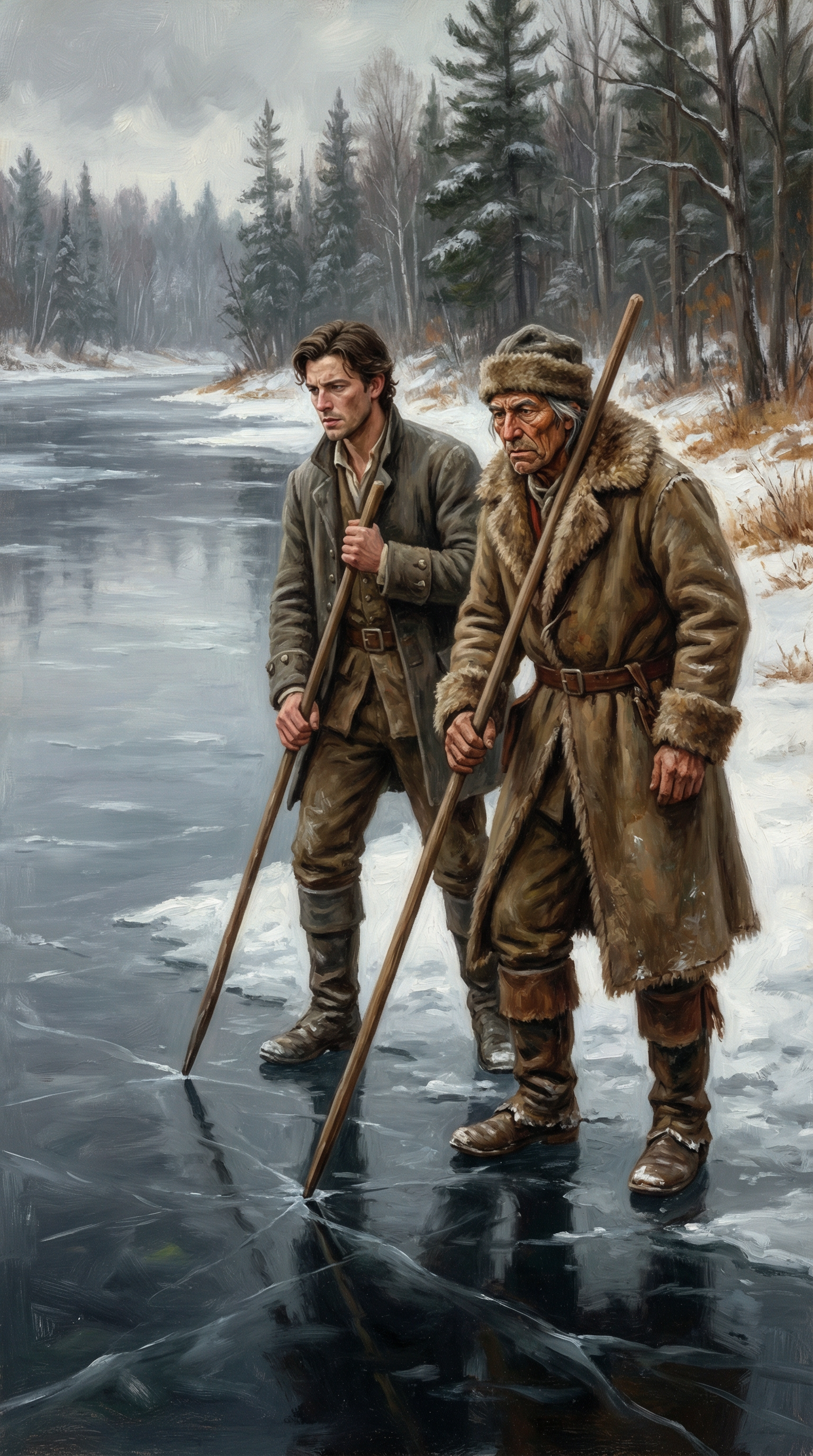
Baptiste teaching Samuel to read ice, mid-December 1774
The morning after the raid, ice came to the shore like an unwelcome relative—sudden, inevitable, rearranging everything.
Samuel woke to Baptiste standing over him with a pole.
“Up. Ice is making. You need to learn to read it before it kills you.”
They walked to where the river narrowed between the shore and a small island. The water had skinned over in the night—thin ice, black as bad news, singing when the current moved beneath it.
“Listen,” Baptiste said.
Samuel listened. The ice made sounds—clicks, groans, a kind of whispered conversation with itself.
“That’s fear,” Baptiste said. “Ice fearing its own weight. When it stops talking, it’s either strong enough to hold you or ready to take you down. Either way, it’s done being afraid.”
He showed Samuel how to test with the pole—not stabbing but pressing, feeling for the moment when resistance became invitation. How to read the color—black ice was strongest, white ice was air and lies, gray ice was dying or being born.
“Your father ever take you on ice?”
“Some. Close to shore.”
“But not out there.” Baptiste pointed to where the channel deepened. “Out there, ice has moods. Like women. Like God. You respect the moods or you swim in December.”
They spent the morning learning ice’s language. By noon, Samuel could hear the difference between ice that would hold and ice that would pretend to hold just long enough to kill you.
“Why does this matter?” Samuel asked. “I’m going back to Detroit tomorrow.”
Baptiste gave him that look again—the one that said Samuel was missing something obvious.
“Boy, you think this is about fishing? About ice?” He spat to the side. “This is about reading what will hold weight and what won’t. Detroit’s full of ice that looks solid. Men who seem strong. Promises that sound good. Most of it won’t hold when weight comes down.”
He pointed at the channel where current had kept a strip of water open.
“See that? That’s truth in winter. Everything else froze, but the current’s too strong there. Always a place where truth runs, even when everything else goes solid. You just need to know where to look.”
They were quiet for a moment, watching the river fight itself.
“The men in Detroit,” Baptiste said finally. “The builders. They think they’re the current. But they’re just ice. Might last the winter, might not. The current?” He pointed at the open water. “That’s people like us. We just keep moving.”
☕ Enjoying this story?
 Buy Me a Coffee
Your support helps keep this serial going. Thank you for reading.
A confederation of Indigenous nations, led by the Ottawa war chief Pontiac, besieged British posts across the Great Lakes region in 1763. The siege of Detroit lasted from May to October, ultimately failing but demonstrating the fragility of British control.
The conflict led directly to the Royal Proclamation of 1763, which attempted to limit colonial expansion westward—a measure that satisfied no one and pleased fewer.
During Pontiac’s War, British officers at Fort Pitt deliberately distributed smallpox-contaminated blankets to Delaware emissaries. Letters between General Amherst and Colonel Bouquet in 1763 explicitly discuss using smallpox as a weapon against Indigenous peoples.
Whether these specific blankets caused the subsequent epidemic is debated by historians. That British officers conceived and attempted biological warfare against civilian populations is documented fact.
Under the Quebec Act of 1774 and earlier revenue measures, British authorities conducted searches of frontier camps and trading posts for untaxed goods. These raids were often arbitrary, targeting French-Canadian and métis communities suspected of trading outside official channels.
The destruction of property during inspections was common and rarely punished. For communities like Baptiste’s, the raids were less about enforcement than about demonstrating who held power.
Ice travel was essential to winter survival and commerce on the frontier. Black ice—clear and dense—was the strongest. White ice contained air bubbles and was treacherous. Gray ice was either forming or melting, equally dangerous either way.
Experienced travelers tested ice with poles, listened to its sounds, and read its color. The ability to judge ice was literally a matter of life and death—and a skill passed between generations through apprenticeship, not books.