The dawn light over the Thumb wasn't so much a sunrise as a slow, bruising fade from black to gray. I pulled the F-150 onto the gravel shoulder of Highway 53 and killed the engine.
The silence that followed was heavy, wet, and cold.
I stepped out, and the damp morning air found the reconstructed joint in my right shoulder immediately. Not just an ache. A specific, jagged signal—the hardware reminding me it was there, the way it always did in weather like this. The pain made me sharp. It made me mean.
I rolled the shoulder, heard the familiar pop, and scanned the scene.
Technically, this was a crime scene. Or at least it had been six hours ago. The erratic red tape the deputies had strung up was already sagging, fluttering lazily in the wind coming off the fields. I ducked under it without hesitation. I respected the field of play—the Bureau had drilled that discipline into me at Quantico—but I had zero respect for the referees who had already blown the whistle and gone home.
I walked to the edge of the pavement. To anyone else, this was just a rural highway. A strip of asphalt flanked by drainage ditches and fallow cornfields.
But I didn't see scenery. I saw engineering.
The crown of the road, pitched to shed water during the heavy Michigan thaws. The aggressive slope of the shoulder, designed to pull vehicles away from traffic if they drifted. The ditch was deep—steep-walled and shadowed. A man could wrestle a woman into a vehicle down there, and a car passing at fifty-five miles per hour wouldn't see a damn thing.
The Thumb isn't a dumping ground. It's a hunting ground.
The isolation wasn't a bug in the system. It was the primary feature.
I moved to the spot where Hendo said Emily Vance's car had been idling. Closed my eyes for a second, running the game tape in my head.
No skid marks. Hendo had been clear about that.
I looked up the road, facing the direction Emily had been driving. If a stranger in a van tries to run you off the road, you swerve. You brake hard. You leave rubber. You don't pull over neatly onto the gravel, put your car in park, and leave the engine running.
Compliance.
That was the only variable that fit the equation. Emily Vance, twenty-eight, X-ray tech, responsible, married. She doesn't stop for a rust-bucket van. She stops for authority.
She stops for a badge. Or lights that look like a badge.
Wipers on. Engine running.
The arrogance of it hit me in the chest. The offender didn't rush. He knew exactly where he was. He knew the response times out here were measured in hours, not minutes. He knew the deputies would see an abandoned car, run the plates, call the husband, and wait. He knew he had a three-hour head start because the system was broken, and he was counting on that break.
I looked down at the ditch. A mess of clay and half-frozen mud.
The deputies would have stood right here on the dry pavement, shining their Maglites down into the gloom, afraid to scuff their issued boots. They would have looked. They wouldn't have seen.
I zipped my jacket to my chin and slid down the embankment.
The mud seized my boots instantly. Cold water seeped through the leather, and my bad shoulder screamed as I used it to balance against the slope. I gritted my teeth and squatted low in the muck.
"Come on," I whispered. "Show me what they missed."
The ground was churned up where the tow truck had likely winched Emily's car out, but I moved further down, away from the focal point. I was looking for the secondary vehicle. The shadow vehicle.
And there it was.
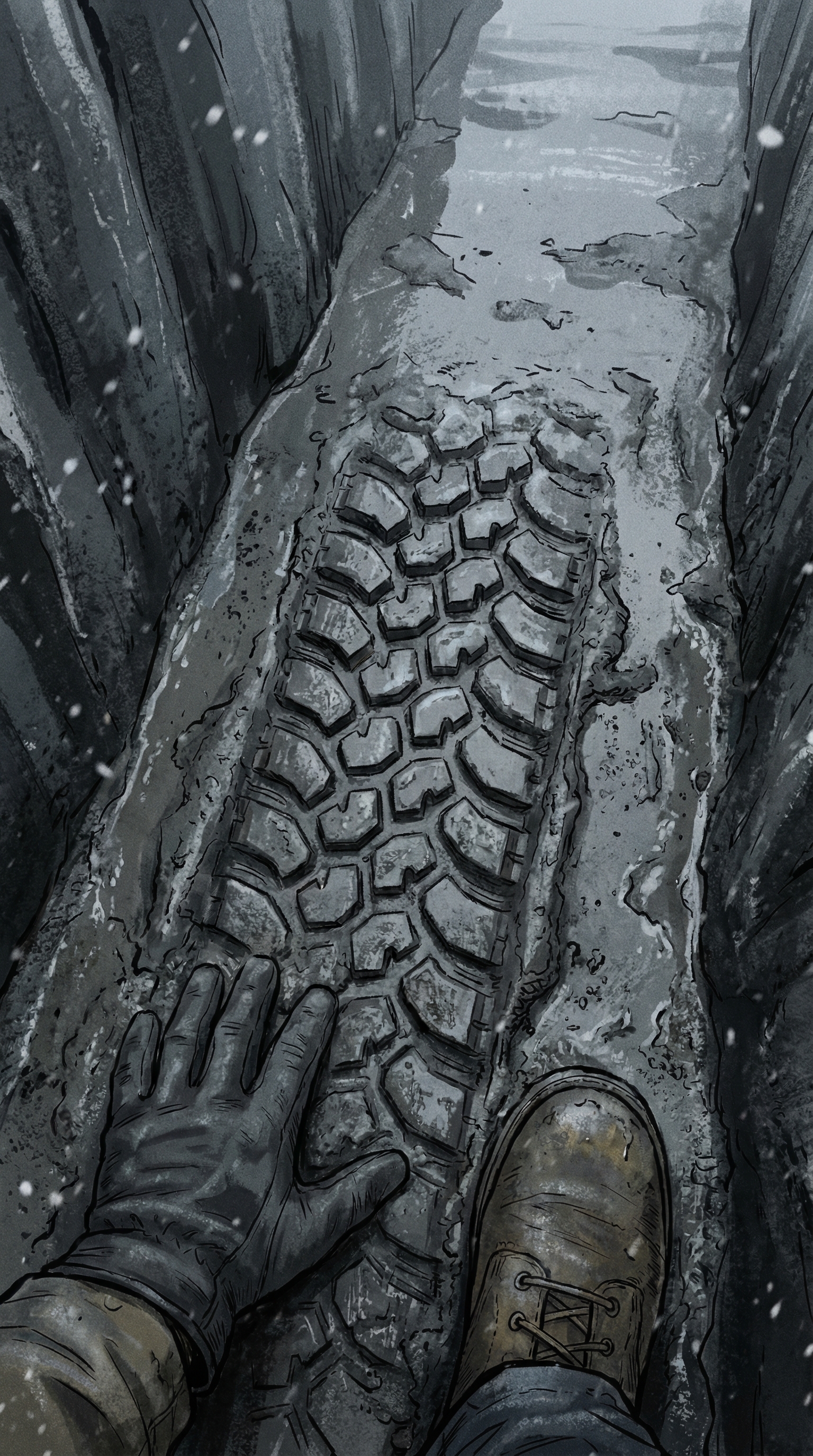
Pressed deep into the gray clay, about ten yards north of where the victim's car had sat. A single, pristine impression.
Wide. Aggressive block tread. Deep grooves designed to chew through snow and construction sites.
This wasn't the bald tire of a drifter's Econoline van. It wasn't a civilian sedan. This was a heavy-duty tire—municipal grade, or maybe utility. The kind of tire you find on a county truck, a surveyor's rig, or a fleet vehicle.
An insider.
The profile clicked into focus, sharp and terrifying. This guy wasn't hunting randoms. He was patrolling. He belonged on these roads. He looked like he was supposed to be here.
I looked back up the steep bank toward the road, visualizing the angle.
The shoes.
Hendo said her heels were found inside the car. Why?
If this was a robbery, you take the purse. If this was a sexual assault that spiraled, you usually find items scattered outside during the struggle.
But the shoes were inside.
It wasn't about the shoes at all. It was about velocity.
"Get out of the car."
That's the command. She steps out. Maybe she kicks off the heels because she can't walk on the gravel in them. Or maybe he grabbed her the second the door opened, pulling her so fast and so hard that she was lifted right out of them.
Organized. This guy had a procedure. He had a kit. He probably had the back of his vehicle prepped with tarps or zip ties. The chemical smell of cleaning supplies—I could almost smell it over the damp earth. He didn't want her car. He didn't want her money. He wanted her, and he took her with the efficiency of a repo man snatching a Honda.
A rumble approached from the south. I stayed low as a county salt truck thundered past, the driver high in his cab, eyes on the road, completely oblivious to the man standing in the ditch below.
The world had already moved on. The sun was coming up. Commuters were going to work. To them, this was just a patch of road.
I pulled my phone from my pocket. Snapped three photos of the tire track—wide angle, close up, and one with my hand next to it for scale.
I needed a paper trail.