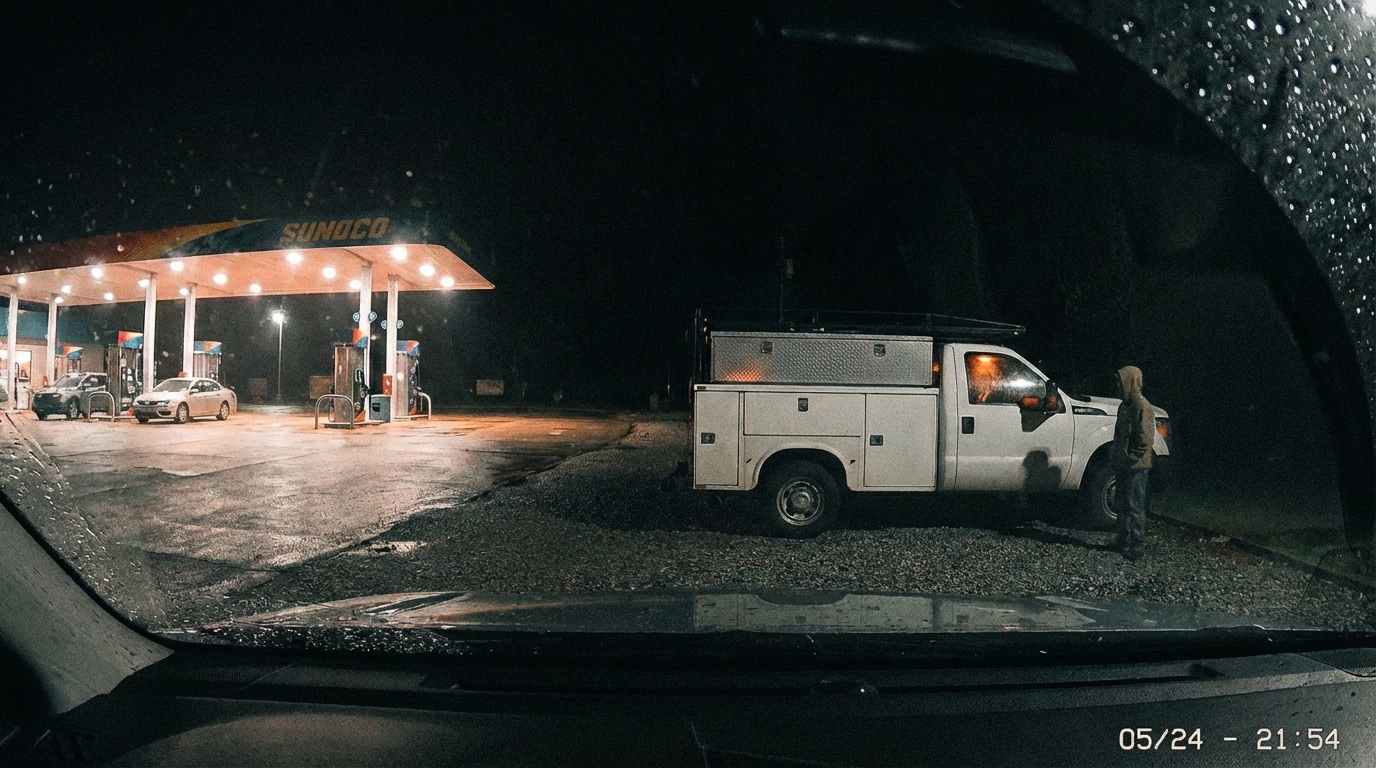
The Sunoco sat at the intersection of 53 and the old Elkton farm road like a beacon in the flat dark—a rectangle of fluorescent light and gas pumps surrounded by nothing. The parking lot was half-empty. A pickup at pump three. A sedan with its hazards on near the air station.
I pulled in and parked away from the pumps. Killed the engine but didn't get out right away.
I'd just left Vance's house twenty minutes ago. Got two miles south on 53 toward Dry Creek and pulled a U-turn in the parking lot of a closed farm equipment dealer. Because the Sunoco had been sitting in my head since Vance told me about the man in the utility truck watching his wife pump gas.
Emily Vance stopped here twice a week. The predator watched her here. And if the predator used this location to surveil Emily, he didn't pick it at random. He was already comfortable in this lot. Already a ghost in the fluorescent light—just another truck, another man buying coffee, another vehicle nobody looked at twice.
Six months ago, Rachel Borowski disappeared on M-24. The routes aren't the same, but the geography is. Out here, M-24 and 53 are the only veins running through the Thumb. You can reach either one from the other in twenty minutes on back roads a local would know blind. And if you're working this territory—hunting it—you'd know every gas station, every intersection, every traffic pattern on both.
The original investigation canvassed the gas station where Rachel last stopped—on M-24, near Silverwood. They asked the clerk, checked the tape that had already been recorded over, and moved on. Nobody ever asked about the Sunoco. Nobody thought to, because the Sunoco is on 53, not M-24, and in a case that was already cooling, nobody was widening the circle.
I got out of the truck and went inside.
The clerk was a kid, maybe twenty, with a wispy attempt at a goatee and earbuds hanging around his neck. He was watching something on his phone propped against the register.
"Help you?"
"Just coffee." I pulled a cup from the stack and filled it at the station by the window. Black. It smelled like it had been on the burner since lunch, but it was hot and that was enough. I brought it to the counter and set down a five.
"Keep the change. Quick question—you work nights regular?"
The kid nodded. "Sunday through Thursday."
"I'm an investigator looking into something that happened on this stretch of road a few months back. Nothing to do with you or the store. I'm trying to find people who are here regularly in the evenings. Regulars who'd notice if something was off in the lot."
"Like customers?"
"Anybody who's here most nights. Nine, ten o'clock."
The kid thought about it for maybe two seconds. "I mean, there's Walt. He's here literally every night."
"Walt?"
"Walt Kubiak. Works at the grain elevator over in Elkton. Stops in every night on his way to thirds. Same thing every time—large coffee, two creams, and a scratch-off. Been doing it as long as I've worked here."
"He here tonight?"
The kid glanced at the clock behind him. 9:47.
"Give it ten minutes."
I took my coffee to the window counter that ran along the front glass and waited. Outside, the pumps threw sharp shadows across the concrete. A county road truck rolled past on 53 without stopping, its orange light bar rotating lazily. I watched it disappear south and filed the detail: county vehicles on this stretch are common enough to be invisible.
At 9:54, a tan Silverado with oxidized fenders pulled into the lot and parked in the same spot I would have picked—close to the door, angled for a quick exit. Habit of a man who does this every night and doesn't think about it anymore.
The driver got out. Late fifties, thick through the chest, wearing a Carhartt jacket that had been washed so many times the brown had gone to gray. Ball cap, John Deere. He walked with the heavy, unhurried gait of someone who works with his hands and his back and stopped being in a rush about anything a long time ago.
He came through the door, nodded at the kid, and went straight to the coffee station without a word. I gave him a minute. Let him fill the cup, add the two creams, stir with a wooden stick. Then he moved to the scratch-off display and studied it the way some men study a wine list.
"Mr. Kubiak?"
He looked at me. Not startled—evaluated. Blue eyes under the cap brim, the kind that have been doing math on people for five decades.
"Who's asking?"
"Jackson Dahl. I'm a private investigator working a case out of Sanilac County." I set my card on the counter next to his coffee. "I was hoping you might have a few minutes."
He picked up the card, read it front and back, and set it down again.
"What kind of case?"
"A woman went missing on M-24 about six months ago. Rachel Borowski. Her car was found on the shoulder south of Silverwood. I'm retracing the area—talking to people who spend time along 53 in the evenings. The roads connect. And the clerk tells me there's nobody who knows this stretch at night better than you."
He bought his scratch-off—a five-dollar crossword—and tucked it in his jacket pocket without scratching it. That told me something. A man who buys a lottery ticket every night and doesn't scratch it immediately has discipline. He's saving it for break time. It's not about the money. It's a ritual.
"I remember that," he said. "The Borowski woman. Had deputies crawling all over M-24 for a week."
"Did anybody talk to you?"
"Nobody talked to me. But it was on M-24. I don't know why they'd come here."
"That's exactly why I'm here, Mr. Kubiak. Because nobody else thought to ask."
He looked at me for a long beat. Then he picked up his coffee and sat down at the window counter, leaving the stool next to him empty.
I sat.
"I'm not going to ask you if you saw anything suspicious. That's a useless question because your brain already decided six months ago what was suspicious and what wasn't, and it filed most of it under normal."
He almost smiled. "You sound like you've done this before."
"A few times. What I'd like to do, if you're willing, is walk through that night with you. Not the crime—just your night. What you did, what you saw, what order things happened. Sometimes the details that matter aren't the ones that felt important at the time."
Walt took a sip of his coffee. Set it down.
"I can try. It was a while ago."
"That's fine. Start with pulling into the lot. Do you remember the weather that night?"
"Raining. Light rain, not heavy. The kind that makes the road shiny but you don't really need your wipers for."
"What time?"
"Same as always. Just before ten. I had to be at the elevator by ten-thirty."
"Where'd you park?"
He gestured with his chin toward the window. "Same spot. Right out front."
"When you pulled in—before you got out of the truck—what did you see in the lot?"
He closed his eyes. I didn't tell him to do that. He just did it, the way people do when they're reaching for something that's still there but buried under six months of grain dust and routine. That told me his memory was worth mining.
"There was a car at pump two. Small, dark colored. Honda or something. Lady filling up." He paused. "And there was a truck."
He stopped. Eyes still closed.
"Take your time."
"A truck at the far end of the lot. Past the air station, near where the asphalt ends and the gravel starts. Big. White or cream colored. Had one of those crossover tool boxes in the bed—the kind that runs across the full width."
"Municipal looking?"
"Could've been. Had one of those magnetic signs on the door, but I couldn't read it from where I was. Could've said county, could've said Joe's Plumbing. At that distance, at night, you can't tell."
"Was anyone in or around the truck?"
"Two guys. One in the cab—I could see the glow of a cigarette or a phone through the windshield. One outside, standing by the passenger side."
"What was the one outside doing?"
"Just standing there. Like he was waiting for something. Had his hands in his pockets."
"Big guy or small?"
Walt opened his eyes. "Smaller. Younger. Maybe mid-twenties. The one in the cab was bigger—I could tell by the silhouette. Wider across the shoulders."
"And this was before you went inside."
"Yeah. Pulled in, saw the truck, didn't think anything of it. Guys on a break. You see it all the time out here—road crews, utility guys, they all stop at gas stations. Went in, got my coffee, bought my scratch-off, talked to the kid behind the counter for a minute. Five minutes, maybe seven."
"And when you came back out?"
He picked up his coffee again but didn't drink it. Held it with both hands.
"The truck was still there. Same spot. But the young one wasn't at the passenger side anymore."
"Where was he?"
"He was walking back to the truck. Coming from across the road—from the other side of 53. Moving fast. Like he was in a hurry to get back."
The air in the Sunoco shifted. The fluorescent lights seemed louder. The kid behind the register turned a page on something and the sound was sharp as a gunshot.
"He crossed from the east side of 53?"
"Yeah. Came out of the dark on the other side of the road, crossed over, and went straight to the passenger door."
"And then?"
"They left. Pulled out, went south on 53. No headlights for the first fifty yards. Then the lights came on."
No headlights. Fifty yards of darkness before the lights came on. That's not a man who forgot to flip a switch. That's a man who doesn't want the parking lot cameras—if there are any—catching his plate on the way out.
"Mr. Kubiak, before he got in the truck—when the younger one was crossing the road, walking toward you—could you see how he moved?"
Walt was quiet for a moment. His eyes went to the middle distance, the place where old memories live when you stop squeezing them and just let them come.
"He had a hitch," Walt said. "Not a limp, exactly. His right foot—or maybe his left, I'm not a hundred percent—it didn't come up all the way. It dragged. Like he was pulling it through the gravel instead of picking it up."
"A drag foot."
"Yeah. A drag foot. I noticed because he was moving fast—almost running—but one leg wasn't keeping up with the other. You know how when somebody's in a hurry and they've got a bad leg, it looks wrong? Like the rhythm's off?"
"I know exactly what you mean."
"I remember thinking, that kid should get that looked at. And then I got in my truck and drove to work and didn't think about it again until just now."
He looked at me. The blue eyes were sharper now, the math running in a different direction.
"Should I not have forgot about it?"
"Mr. Kubiak, you just told me something six months of police work didn't turn up. You did fine."
I thanked him. Shook his hand. Told him I might need to talk to him again and he said I knew where to find him. Same stool, same time, every night. He picked up his scratch-off and his coffee and walked out to his truck with the same heavy, unhurried stride, and I watched him pull out of the lot heading east toward Elkton and the grain elevator and the overnight shift that had been his life for however many years, and I thought about how much the world depends on men like Walt Kubiak—men who show up, who notice things, who remember them without knowing they're remembering, and who will sit on a gas station stool and give you the truth if you just ask the right way.
I sat in the truck in the Sunoco parking lot and didn't start the engine.
Two men.
Not the "maybe two, maybe one" from the original Borowski witnesses who were driving past at fifty-five and saw five seconds of something through rain-smeared glass. Two men, confirmed. A hierarchy. One dominant, one subordinate. The bigger man stays in the cab. The smaller man crosses the road on foot, does something in the dark on the east side of 53, and comes back in a hurry with a drag foot that says old injury, congenital condition, or both.
The same two-man profile the Borowski witnesses had sketched in fragments. One doing the moving. One staying by the vehicle. But now it had texture. Now it had a body.
At the Bureau, we called them dyads.
Two-man predator teams. They're rare—most serial offenders work alone because partnership requires trust, and trust is a currency psychopaths don't carry. When you do find a pair, there's always a structure. Always one dominant and one dependent. The dominant selects, plans, controls the operation. The dependent executes, obeys, and stays loyal because the alternative—being cut loose, being turned in, being alone with what he's done—is worse than what they're doing together.
The dominant is almost always older. Smarter. More socially fluent. He's the one who wore the vest and carried the clipboard to Emily Vance's front porch. He's the one who used the dead-phone pretext, calibrating her response, reading her empathy like a gauge. That takes confidence. That takes a man who's been in people's homes before, in some official or semi-official capacity, and knows exactly how far he can push the door open before it pushes back.
The dependent is younger, physically compromised, psychologically bound. A nephew, a stepson, a kid who grew up in the shadow of a man who shaped him into an instrument. The drag foot makes him identifiable and therefore controllable—he can't disappear. Can't start over in a new town without someone noticing the young man with the bad leg. Can't walk away from the partnership because the dominant chose him precisely for the limitation. A man who can't run is a man who can't leave.
I'd seen it before. Twice, at the Bureau. Both cases out of the NCAVC corridor at Quantico, both cross-jurisdictional, both running for years before the pattern surfaced. And in both cases, the dominant was the one who evaded capture the longest—because the dependent was the one people noticed, the one witnesses remembered, the one who left traces.
The dependent always breaks. It's a matter of when and how hard you push.
I started the engine.
I had a vehicle type—municipal, utility, crossover tool box across the bed. I had a two-man team with a clear hierarchy. And I had a physical signature: a young man, mid-twenties, with a drag foot that turned every step he took into something people remembered.
Somewhere in the Thumb, somebody knew this kid. A neighbor who watched him grow up wrong. A doctor who treated the leg. A teacher who remembered the boy who couldn't run in gym class and the uncle or the stepfather who always picked him up. And that somebody knew who he belonged to.
I pulled out of the Sunoco lot and headed south on 53. The road was empty, dark, and patient—the way it always is out here, the way it was the night Rachel Borowski trusted the wrong lights in her mirror, the way it was every night the man in the municipal truck sat in this parking lot and watched and waited and chose.
The hunt had just narrowed to a radius I could work.