The Sanilac County Impound Lot was less a facility than a geological feature—a five-acre scar of gravel and mud cut into the scrubland north of Marlette. It was surrounded by twelve-foot chain-link fencing topped with razor wire that had rusted to the color of dried blood.
I parked the truck next to the intake trailer. The structure was a corrugated aluminum box that had been temporary twenty years ago, now anchored permanently by weeds and neglect. The air here smelled of oil, wet iron, and the specific, briny scent of vehicles slowly dissolving under the influence of Michigan road salt.
Hendo was already there, leaning against his patrol cruiser. He wasn't wearing his hat. His breath plumed in the cold air, short and angry.
"Tell me you got something," Hendo said. He didn't offer a hand. His eyes were red-rimmed.
"I got mud," I said, stepping out. "And a picture you're not going to like."
I pulled up the photo of the tire track on my phone—the deep, blocky tread pressed into the clay. Hendo took the phone, zooming in with a thumb that trembled slightly.
"That's not a civilian tire," Hendo muttered. "That's a ten-ply off-road tread. Municipal. Or construction."
"It was deep in the ditch," I said. "Deputies didn't see it because they didn't go down the slope. It matches the witness from the Borowski case—the 'van' wasn't a minivan, Tom. It was a work truck. A utility van."
Hendo handed the phone back. He looked at the intake trailer, then back at me. The Flint mask slipped over his face—a hardening of the jaw, a deadening of the eyes. The look of a man who had policed a city where violence was atmospheric pressure, constant and crushing.
"Let's see the car," Hendo said.
We walked into the trailer. Inside, the air was stiflingly hot, smelling of stale coffee and photocopier toner. Behind the counter sat a clerk named Miller—a man built like a sack of feed, wearing a stained polo shirt. He was watching a portable TV and didn't look up.
"Sign in, Deputy," Miller grunted, sliding a clipboard across the Formica without looking away from the screen. "You know the drill. Processing fee is waived for official—"
"Miller."
Hendo didn't shout. He didn't have to. He used the voice I remembered from the old days—the voice that could stop a bar fight in Hamtramck without drawing a weapon.
Miller finally looked up. His face went through a quick calculation—annoyance to recognition to something like caution.
"Deputy Henderson. Didn't see it was you."
"The blue Civic that came in last night. Highway 53. Where is it?"
"Bay four. But the state boys already—"
"I don't care what the state boys did. Keys."
Miller reached under the counter and produced a tagged ring. "Sign the log. Chain of custody, you know how it—"
Hendo signed without reading. He was already moving toward the back door.
Bay four was a concrete pad with a corrugated roof, open on three sides to the wind. Emily Vance's Honda sat in the center, looking small and ordinary and wrong.
The driver's door was still open from when the tow driver had hooked it. The engine was off now, but I could still see the condensation on the inside of the windshield—ghost breath from a woman who wasn't coming back to fog it again.
I pulled on nitrile gloves and approached from the passenger side, staying wide of the door. Hendo hung back, arms crossed, watching.
"State police already processed it," Hendo said. "Lifted prints. Took samples. Found nothing."
"State police processed the obvious," I said. "They photographed the steering wheel and the door handles because that's what the manual says. They didn't ask what the scene was trying to tell them."
I leaned into the passenger side, scanning the interior.
The purse was still on the seat—a brown leather thing, medium-sized, zipped closed. Nobody had taken her money. Nobody had taken her phone. This wasn't robbery.
But it was the floor mat that made my chest tighten.
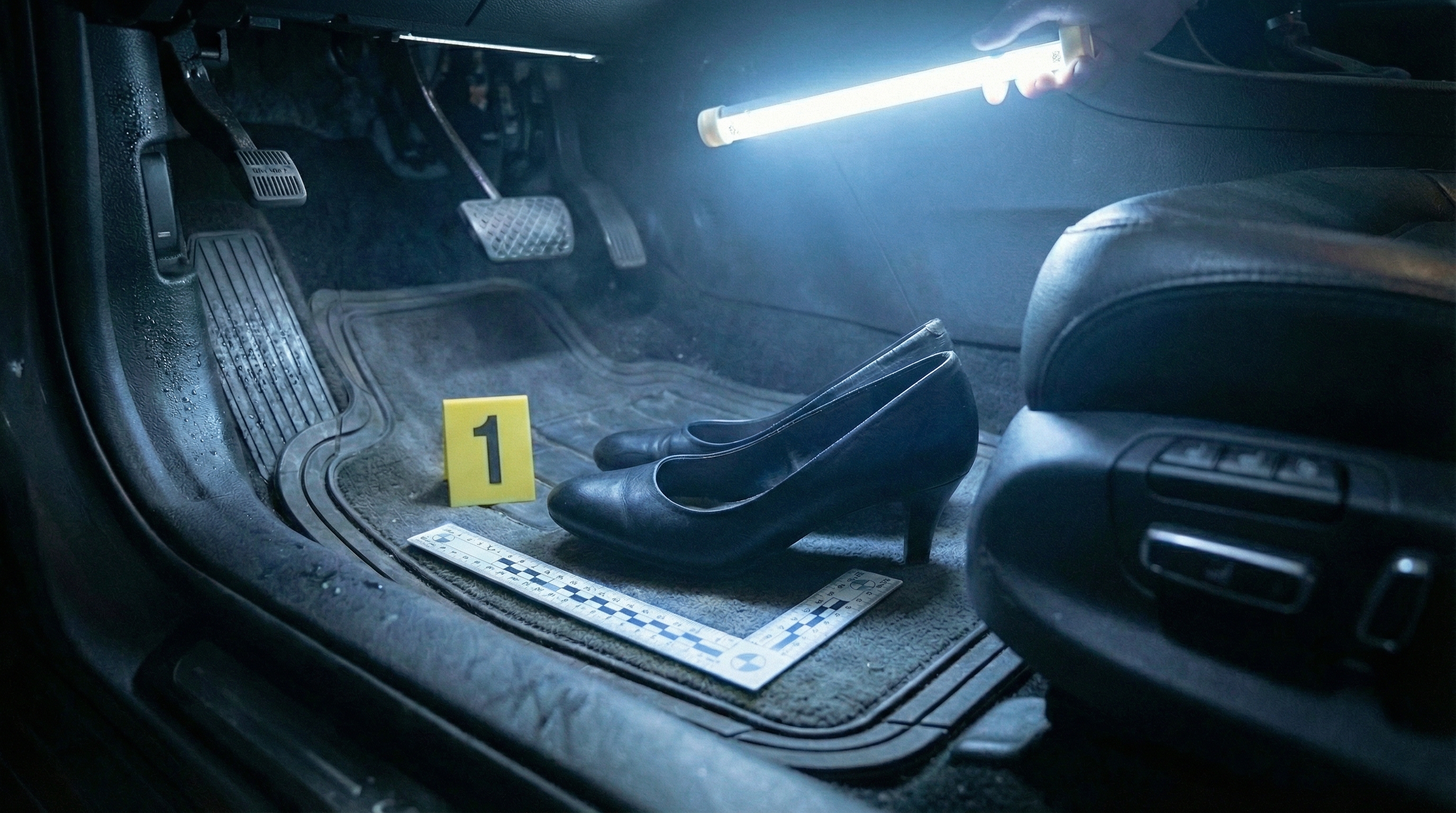
Two shoes. Black heels, maybe two inches, the kind a woman wears to look professional but still walk a hospital corridor. They sat neatly on the mat, toes pointing forward, as if their owner had simply stepped out of them and floated away.
"The shoes," I said quietly.
"Yeah."
"She didn't kick them off in a struggle. Look at the placement, Tom. They're parallel. Neat." I photographed them from two angles. "She stepped out of them deliberately. Either because he told her to, or because she was trying to be cooperative. Trying to make it easier so it would be over faster."
"Compliant," Hendo said. The word was flat.
"Trained to be compliant. We all are. Someone with a badge tells you to step out of the car, you step out of the car. You don't kick, you don't scream—not yet. You think this is a traffic stop that went sideways and if you're just calm enough, just polite enough, it'll go back to normal."
I opened the glove box. Registration, insurance card, a packet of tissues, a AAA card. Closed it.
"By the time she realized normal wasn't coming back, she was already gone."
I moved to the driver's side. The seat position caught my attention—pushed back further than a 5'4" woman would need it. Someone taller had sat here. The tow driver, probably, but I made a note anyway.
Then I smelled it.
Faint. Almost gone. But there—under the new-car smell and the human traces—a chemical sharpness. Astringent. Familiar.
"You smell that?"
Hendo leaned in, inhaled. His face changed. "Cleaning supplies. Same as the Borowski scene."
"Chloroform aerosol, if I had to guess. Or something like it. Quick-acting. He didn't wrestle her into a van—he dropped her where she stood and loaded her like cargo."
I stepped back from the car.
"He's organized, Tom. He's got a kit. He's got a vehicle that belongs on these roads. And he's done this enough times that he's got a procedure. Badge, lights, compliance, chemical takedown. Sixty seconds, maybe less, and she's in the back of his truck."
"So who the hell is he?"
I stripped off the gloves. "Someone who drives a municipal vehicle. Someone who knows this stretch of road. Someone who's patient enough to wait six months between victims." I looked at Hendo. "Someone who might even have access to know when a case goes cold."
The implication hung in the air like the chemical smell.
"You're saying—"
"I'm not saying anything yet. I'm saying the profile fits someone with authority, access, and local knowledge. Could be county. Could be utility company. Could be a contractor who works the roads."
Hendo's jaw worked. "State police won't touch that theory without evidence."
"State police won't touch anything that makes their paperwork complicated." I pulled out my phone, scrolled to the tire track photo. "This is a start. But I need to know what other vehicles were on that stretch of road. What work crews, what county trucks, what utility vans."
"That's a records request. That takes time."
"Time Emily Vance doesn't have." I pocketed my phone. "If she's even still—"
I didn't finish. We both knew the statistics.
"What do you need from me?" Hendo asked.
"Keep the Borowski file warm. If anyone asks, you're just doing due diligence—new case, similar circumstances, making sure there's no connection."
"And what are you going to do?"
I looked at the blue Civic one more time. At the shoes on the floor mat. At the purse full of things a dead woman wouldn't need.
"I'm going to talk to the husband. Find out who Emily Vance was. Where she went, who she knew, what routes she drove."
"Victimology."
"Victimology. And then I'm going to find the paper trail the system was too cheap to file properly."