The Books on My Shelf (and in My Ears)
Something peculiar I’ve noticed about myself: I listen to an awful lot of audiobooks, and often I’ll buy hardcover copies of the ones I really want to keep—the ones that are special to me. I also shop at new and used bookstores. I’m a big supporter of small businesses, especially bookstores and record shops. I think they’re culturally significant in ways we don’t always appreciate. There’s nothing like walking into a place with creaky floors where you meet the owner or someone who just likes working there for the love of curating works of art.
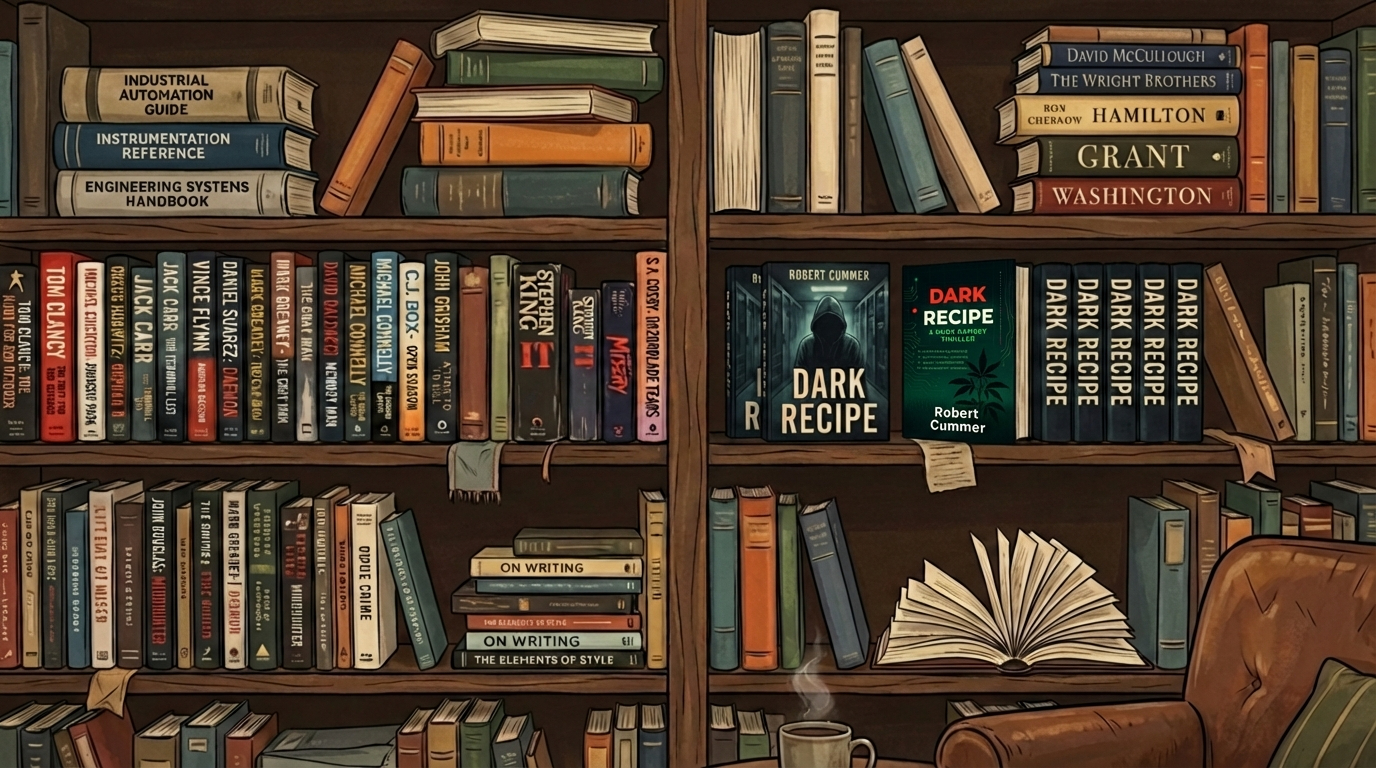
I’m writing this post to share which authors have influenced me—either in my life generally or specifically in my writing. Some I simply enjoyed reading. Others shaped how I think about storytelling.
History Through My Family’s Eyes
I tend to read a mix of pop culture, biography, and history books, generally from timelines my family lived through. Growing up in the 1980s meant the Reagan and Bush 41 era, then Clinton, then W. But I’ve also spent a lot of time with books about Vietnam because of my father and two of his brothers who served. I’ve read some about the forgotten war—Korea—and quite a bit about World War II. Then there’s a gap before I circle back to the Civil War, the Revolutionary War, and now I’m reading about the pre-Revolution era as I trace my genealogy and learn when ancestral lines immigrated to what would eventually become the United States.
There’s also a personal dimension to some of this reading. I’ve read a fair amount about our three-letter agencies, especially after discovering that my maternal grandfather appears to have been involved with early Marine Corps OSS operations during World War II. On my father’s side, my paternal grandfather—also a Marine—served on Guadalcanal and kept a secret diary. One of my uncles transcribed it and shared it with the family. He revealed nothing classified (he wasn’t exposed to anything classified to begin with), but his notes are a treasure to us.
The Historians Who Taught Me to Write
Outside of family history, I have a deep love for the work of David McCullough, and more recently, I’ve been getting into Ron Chernow. I like them both for different reasons.
McCullough taught me that history doesn’t have to be boring. The rich color and texture he brings to a time period and its people make you feel like you’re right there. Reading about Paul Revere’s midnight ride, I felt like I could have been on horseback alongside him, feeling the tension, not knowing what was around the corner—whether he’d live or die.
Chernow writes like he’s composing a doctoral thesis. I have to focus and concentrate, and I know I’m in for a long haul. But because of him, when I read about Ulysses S. Grant, I learned things I never would have known otherwise—what a hero he was, and also how trusting and foolish he could be with people and money. I’m currently reading Titan, his biography of John D. Rockefeller. It’s about 900 pages.
I also just acquired McCullough’s The Great Bridge, about the construction of the Brooklyn Bridge. I haven’t started it yet, but I’m excited. It’s not just about how they built a bridge—I want to know how they convinced people to construct such an engineering marvel at that time in history. And selfishly, I want to learn how to write better. How do you take intricate, detailed stories full of politics and engineering and make them palatable—even enjoyable—for readers? That’s what I’m studying.
True Crime and the Behavioral Mind
I’ve read a fair amount of psychological nonfiction, particularly related to the FBI’s Behavioral Sciences Unit. That world has always fascinated me—John Douglas and Mindhunter especially. Some of that reading has influenced the fiction I’m working on that’s truth-based in that area.
Fiction That Shaped Me
Let me talk about C.J. Box for a moment. I was introduced to him backwards, the way many of us experience authors these days—I watched the television show Joe Pickett first, then picked up a book. Then I found out one of my old sandbox buddies from my days on Wilman Drive has read the entire catalog, so I started working through them. They’re incredible. Joe Pickett is essentially a game warden in Wyoming. He has a family. How could that be exciting? But it really is. Box turned a seemingly ordinary character into a deep, humble, everyday hero stopping crime from a variety of antagonists.
I also like Michael Connelly. I’ve read his entire catalog—dare I say his corpus. I’ve enjoyed nearly all of it, though there are a few I didn’t care for. But what a wonderful crime series set in Los Angeles.
John Grisham I enjoy tremendously. I haven’t read all of his work, but I’ve read quite a bit.
Dan Brown fascinates me. For those who don’t know him by name, they probably know him from Angels & Demons, which became a hit movie with Tom Hanks. He’s written several books since, including The Da Vinci Code and his latest, which I’m also reading.
Permission to Build a Foundation
Of the fiction writers I mentioned, Tom Clancy, Michael Crichton, and Jack Carr taught me something important: it’s OK to have exposition as long as it moves the story forward. That includes a prologue and an epilogue.
The prologue comes into play for me because I don’t like cartoon villains—at least not in bigger stories. There’s always more than one side. There’s the truth, there’s the other truth, and then there’s the truth somewhere in the middle. Each of these writers took their craft and provided background, a basis, a foundation. They start with the why and the how.
When I was getting ready to publish Dark Recipe, I had to figure out how to categorize it. What genre? And I’m very self-aware that I can’t always answer a simple question with a yes or no—even though as an electrical engineer I deal in binary systems. Ones and zeros. On or off.
But those who are electrical engineers reading this (or reading my books) will tell you: a zero isn’t really zero. It’s between 0 and 2.7 volts. Then there’s a small range in the middle—an unknown state. And to be “on,” you might need 3.8 to 5 volts. You get the idea. There’s always a threshold. Even with discrete outputs, there’s always something in the middle.
That’s how I feel about genre. My books are geopolitical. They’re technical. You could argue they’re psychological in nature. When it comes time to sell, you have to make marketing decisions—pick a category, check a box. But some people might consider my work to be literary fiction. I’m writing messages in these books. I’m expressing my thoughts. I want people to think about things. I’ll get into that more in another blog post specifically about Dark Recipe, but for now, just know that the genre question isn’t as binary as it seems.
What do you do with that middle? In electrical engineering speak, you’re tri-state. Undefined. Depending on your perspective.
In writing, that middle ground lets the reader decide.
Some people have a problem with that. It’s like the ending of The Sopranos—the family’s alive, Tony’s alive, and then it fades to black. You don’t really know. Even when the writer says he intended for Tony to die… did he? You don’t know. That’s what I’m getting at. That’s why the background matters. That’s why the prologue matters.
I hope as I continue to write that I’ll learn to be as concise as I am precise. We’ll see. But those writers gave me permission—not to write endlessly, but to lay a foundation. Because the stories they write are complex. Nuanced. Many layers. More than one plot line.
For someone like me, I love that. My life has never been a straight path. Very curvilinear. From the day I was shot out of the womb, nothing has been easily laid out in front of me. I’ve had help along the way—don’t get me wrong—but if there’s a slight chance something could go not according to plan, that was me. You learn to adapt or you don’t survive. Plans and rules have largely been treated as suggestions in my life.
The Field Guide: What Didn’t Fit in the Book
My first book, Dark Recipe, was way too technical in the early drafts. So I decided to use some of the skills I have from my career in automation and custom software development. I created what I call a Field Guide at knoxramseythrillers.com.
I threw a lot of the material I couldn’t get away with in the story—or at least thought I couldn’t—into the Field Guide. The pacing was already slow in some areas, and I knew that too much exposition would lose some readers. At first, I was a little arrogant about it. I thought, “Well, if they don’t want to read it, then don’t read it.” But that’s not really my intention. I want someone to enjoy the story. I want them to go on a journey with me.
So I built the Field Guide. I use that term because it’s how an engineer or scientist would document things. It’s behind the scenes. Behind the curtain. And honestly, it became a lot of fun. Having a website I could manipulate—adding color, richness, interactive elements—was a creative outlet I didn’t expect.
If someone wants a more immersive experience after reading the book, they can visit the site. Or during the reading. There’s more background, more explanation of the science, and citations, too. I stated it in the book, but I’ll say it again here: all the science in Dark Recipe is real. It’s not science fiction. It’s fiction based on science. I think there’s a difference.
Introspection and Influence
Gregg Hurwitz was also a tremendous influence, but not in the same way as the others. His influence was about introspection.
His Evan Smoak character—Orphan X—has a lot of internal reflection. I tried to leverage that influence as much as I could. Orphan X has extensive combat training. Hand-to-hand. He’s skilled and deadly. James Reece in Jack Carr’s Terminal List series is a former Navy SEAL, also highly trained. There’s tremendous technical depth in those books, and the combat scenes are intense.
Tom Clancy, a former insurance salesman (which I love), brought tremendous technical depth and detail. He wrote about the Cold War era and the Soviet threat at the time.
And then there’s Michael Crichton—a medical doctor who became a writer. Many of his books were prescient. In my own way, I wanted to honor him and his influence in Dark Recipe. The level of precision and accuracy I tried to achieve in the trauma scenes set in Detroit emergency departments was largely because of him—and because of my family members who’ve worked in healthcare.
Beyond the Page
There are other people who’ve influenced not necessarily my writing, but my personal life.
One book I’ve been thinking about frequently is Can’t Hurt Me by David Goggins. It’s an incredible story of determination, perseverance, and an engine that won’t quit. He was a morbidly obese kid with a hard-scrabble upbringing who became an ultra-marathon runner. In between, he became a Navy SEAL. His story is emotional. It makes you want to be a better person. It’s about taking extreme ownership of your life. No excuses.
I’m not there yet. But I strive for it. I strive to be a better person. That drive comes from my friend group, my family, and these influential writers.
I know there will be more to say in the days, weeks, months, and years to come. But that’s it for now. You have a bird’s-eye view of the authors who’ve influenced me. I’m sure I’ve left some out—but don’t worry. I’ll make it up in another post.
Comments