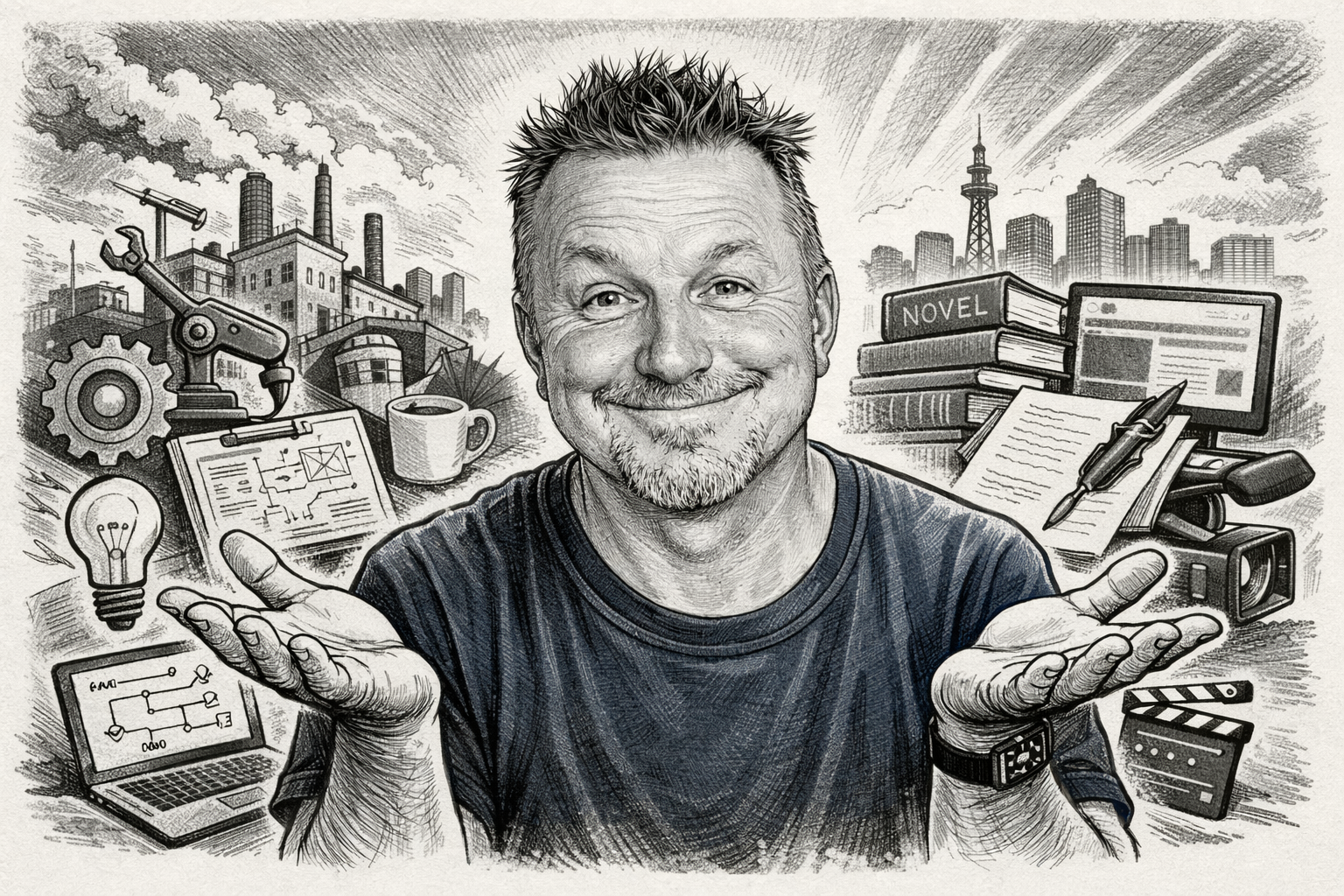
There’s a moment in every career when you realize the job title on your business card doesn’t actually describe who you are. For me, that moment came somewhere between leaving Dow Chemical, getting laid off during COVID, starting two companies, co-founding a produce company, and deciding — apparently without consulting my better judgment — to write novels.
For thirty years, I was an automation guy. That was the identity. Walk into a plant, look at a broken system, figure out what’s wrong, fix it, move on. I had two patents, a career I was proud of, and a very specific lane I drove in. If you’d told me five years ago that I’d be formatting manuscripts in Vellum, obsessing over cover designs, and preparing for a live television interview about a techno-thriller I wrote, I would’ve asked what you were drinking and whether you’d share.
But here’s what I’ve come to understand, and it took me longer than it should have. The skills that made me effective in automation — pattern recognition, systems thinking, troubleshooting under pressure, translating complex information into something a technician on the floor at 2 a.m. can actually use — those aren’t automation skills. They’re thinking skills. They’re communication skills. They’re problem-solving skills wearing a hard hat and steel-toed boots.
We do this thing as a society where we define people by their vocation. You’re a plumber. You’re a nurse. You’re an engineer. And we start to believe it ourselves. I know I did. But your vocation is really just a set of tools you’ve been trained to use in a specific context. The underlying abilities — the capacity to learn, adapt, analyze, and create — those travel with you no matter where you go.
When I started writing Dark Recipe, I didn’t sit down and think, “I’m going to use my automation background to write a thriller.” But that’s exactly what happened. The way I structure a narrative isn’t all that different from how I’d approach a system integration project. You identify the inputs, you map the process, you anticipate where things can fail, and you build in redundancy. Characters are like field devices — they each serve a function, and if one goes offline, the whole system feels it.
The same thing happened when I started building companion websites for my books. I wasn’t learning a new skill from scratch. I was repurposing decades of technical documentation experience into a different medium. The content changed, but the discipline didn’t.
I think about the people I’ve worked with over the years — electricians, mechanics, tool and die makers, process engineers — and I wonder how many of them are sitting on a second act they haven’t considered because they’ve boxed themselves into a single identity. You’re not your job title. You never were. You’re the sum of every problem you’ve solved, every system you’ve understood, every time you figured something out that nobody else could. That doesn’t expire when you change industries.
So if you’re reading this and you’ve been thinking about doing something outside your lane — writing, teaching, starting a business, learning to weld, whatever it is — stop asking yourself if you’re qualified. Ask yourself if you’re willing. The skills will transfer. They always do.
You just have to be stubborn enough to let them.
Signed, The Ringmaster
Comments